Showing posts with label eLearning. Show all posts

Friday, March 23, 2012

Future of Attribution?

During the FutureOfEducation web seminar I attended today, I managed to ask David Warlick a question regarding attribution:
There seems to be a broadening of attribution from traditional books & journals to all sorts of online media such as blogs / podcasts / even presentations like this. At the same time there is another method of attribution gaining popularity: that of the kudos to another user in web 2.0. EG: like button for facebook, or +1 in Google +, or the kudos in slashdot, or the the favouriting of images in flickr.
  
Do you believe that these two systems will eventually merge where attribution goes from a simple +1 all the way up to published works?
 It didn't come out as eloquently as I'd written it, but David's response went a different direction than what I was expecting. He mentioned that attribution is having a resurgance in schools now as a focus for critical thought. Instead of simply attributing an idea to another authorative source, the degrading of authorative sources on the net means that students need to be able to create their own critical analysis and apply their own logic to the problem.

Sounds like a little bit of swings & roundabouts as I'm sure those same set of students will find out (possibly at Uni) that standing on the shoulders of giants allows a more targeted analysis for those developed critical thinking skills.

Saturday, December 03, 2011

Last day

Open space ...
Last day at St Luke's came to a somewhat sad close as I packed up my desk. Everything I needed to keep all fit into my backpack, and a lot of paper went in the bin. I guess I'm lucky that most of my work is already digital and constantly with me anyway.

Thanks for the year must go to:
Chris: An excellent mentor and unfortunate neighbour to cope with all my questions.
Cassie: A great HoD who gave me a lot of support with my wild ideas for teaching. Thanks for all the help in verification, moderation and reporting.
Martin: Helped guide me into teaching when it was really only a wistful idea. His support and that of the school has given me the absolute best transition into teaching that I could have hoped for.

I know I'll be back next year in a limited capacity, but it really felt like leaving for good. St Luke's has been a wonderful place to work at for the past 6 years, and I'll have many fond memories & friends from the experience.

So why leave?

I'd been constantly asked that by all sorts of people at St Luke's. I had a standard response, and longer response and a how-long-have-you-got response, but really it came down to a feeling of entrapment. I've been heavily involved with computers and IT for the majority of my life, and even while teaching I would have put IT as about 2/3rds of my focus. Without the ability to teach IPT in the senior curriculum there's a big chance that I'd have to lose more and more of that IT experience as I become more heavily teacher focused. If I kept going, there would be a good chance that I would be teaching for 3 years or more, and that would pretty much rule me out of returning to the IT industry. I still like teaching, but resigning was a way to force me to look for other opportunities that may have both an IT and teaching focus.

There are many companies that are getting close to my vision of future learning and maybe I should be working heavily in that area. I know I don't have the entrepreneurial drive to go out by myself, but if I could guide some other companies a little closer to the end goal, then that would be a worthwhile contribution.

I'm still keen on giving University lecturing or some form of adult education a go. I have strong reservations about the way Universities are when MOOCs and open learning are becoming viable alternatives, but I'm not sure how to monetise the new breed of courses. What I definitely want to do is to put more work into my own model. Flesh out all the parts into a full design. Hopefully this will both force me to look beyond my own ideas and see what else is out there for referencing, and also help isolate specific opportunities to aim toward.

There is also some local opportunities to get back into tech support and business analysis. I must say that the best part about contract programming was getting right into the heart of a business and looking for ways to improve existing processes (whether that was through a program or not). If that opportunity comes up like I imagine, it will be a good change.

On the programming front, I'm also keen on getting back into working with Notorious. I'd made a bit of progress last time Andrew came down, but when I'm teaching it really felt like any time devoted to anything else was guilt-ridden. I think that'll be another post...

Like David, I'm also keen on getting back into more regular blogging. This one is a pretty good sign that being out of teaching mode will help.   


Thursday, July 23, 2009

Full Immersion 2025 - A vision of the future

Wow.

A casual Diigo link to the Colorado Virtual Academy this afternoon had me interested. I'm always on the lookout for virtual learning environments that match my ideas of the way to the future, and this link just kept ticking the boxes.

First off I noticed "An individualized approach to learning". Now that term has been bandied about a lot recently without really any substance to it, but paired with a virtual environment it is possible and a main goal of my VR dream .

A bit further down the page and another cathphrase pricked my ears: "An ideal fit for accelerated learners". Having completed an assignment last term on how to manage gifted and talented students in the current curiculum and also the implications of accelerated learning in a VR environment, it seemed likely that we might be on the same wavelength.

Digging into the accelerated learners section confirmed my suspicion: "The K-8 curriculum is mastery-based, enabling students to advance when they're ready—not when the rest of the class is." Wow. First time I've seen that type of thought expressely used in an established learning institution. I'm excited!

Looking deeper into the K-8 curriculum I find another component of my model: "And with more than 700 lessons per subject, he can dive deeply into areas of interest." Yes! A curriculum exploded into bite size chunks. No real indication of a meshed list of prerequisite skills, but nothing to the contrary either.
Opening up the individual courses it starts to sound more like an ordinary school approach. I got excited that "From helping younger students make the link between the concrete and the abstract to introducing older students to Algebra" might mean having an intrinsic peer mentoring approach, but upon reading it again it's really just showing the breadth of the whole course.

A phrase appeared a couple of times that didn't really make much sense: "Big Ideas + Consecutive Down Payments + Practice = Mastery". Found out a little later on that the downpayments are the stepping stones to the big ideas. Makes more sense now and shows the benifits of an adaptive curriculum.

Through tea I was really excited on how close it matched my model. The closest by far. I dug up a blog of Bror Saxberg for my google reader and the first article caught my eye: "A vision of the future", where he expands on his participation in a published article on how 10-year olds will learn in 2025. This article is amazing! It's like reading something I would have written myself. Our visions of a future educational environment through VR are almost identical!

I really like the implementation of the helper AI (yoda). I'd dumped most of the AI elements from my model as I wanted it to be as believable as possible to the Uni lecturers I was presenting the model to without having to explain the intricacies of tracking AIs, shadow AIs, Tutor AIs and helper AIs (which was a big part of the vision in my early days; I guess that's because AI was a big hobby for me back then). I still think that a yoda helper AI is still further off than 2025, but then again it depends on the scope of something like Project Natal. Having AI's able to learn standard answers from real teachers and tutors would then be able to fill in forums / FAQ sessions in the absence of a real tutor. I had always envisaged helper AIs saying things like "You answer is most likely ..." to give the relative confidence to the learner on the veracity of the answer given, and being able to show the pieces of information that made that assumption if questioned.

For me the big part for AI's to play is through "shadowing". For every student you have a shadow AI that attempts to emulate the thought processes of the student. It tries to predict what questions the student will get right, what they get wrong, etc. With those "aha" moments in learning where the patterns and processes finally click into place, there will be a big positive spike in the error between the shadow AI and the student. This can be used to trigger the next phase of learning. The shadow AI can also be used for system wide testing, where it can be interrogated and compared to other student's AIs for help in choosing the next course to take. Bror's vision seems very close, but relying more on the student's actual results to make the system learn how to educate that student better.

The role of educators in both systems seems very much inline. I think that through the Uni course I'm concentrating more on allowing different learning styles to be catered for through the variety of courses on offer to achieve the same skillset, whereas Bror focuses more on deep database analysis.

Deep database analysis is one area where Bror's model seems more advanced than what I had imagined. His use of data mining techniques to shape the curriculum seems more solid than the shadow AI approach. Both systems would compliment each other though; shadow AIs would just give more data for analysis.

So pleased that I found this link and Bror's ideas. I'm over the moon that someone has demonstrated what I'd been contemplating for a long time. Well, not everything's implemented yet, but with someone at the helm with such a closely aligned vision I can see exactly where the boat is going...
I want on ...

Tuesday, June 02, 2009

Google Wave - a saviour to fragmented conversation


22 minutes in to the Google Wave demo and I see the massive impact this is going to have. I recently wrote up a comment on Sue Waters' blog regarding the reasons why Twitter is not better than comments, but it changes the conversation due to massive fragmentation (well, twitter is the not the only culprit, but without trackbacks it expedites dispersion of the conversation). Now, with wave, we can have the best of both worlds: An easy method for containing and collating the conversation, but allowing the freedom to access the conversation at your leisure using the tools that you want. It's the philosophy of RSS, but applied to the whole conversation.

You know what this means? Death to twitter. Life to blogs as conversation starters!

Your wave reader will totally replace the RSS reader as it gets around that messy issue of checking separate RSS threads for comments, or missing a jump in the conversation over to a new blog. Hoorah!

25 minutes in and the death toll rises. SMS can disappear forever! Unfortunately it also means that I'll have to seriously think about a data plan for my next phone as well as wireless.

29 minutes in and I'm now regretting spending 2 hours last night setting up a Diigo account instead of working on my assignment. Actually why am I wasting more time typing this up? Deep down I know why; I'm excited. I'm researching stuff and learning through my PLE and I'm enjoying it.

30 minutes in and playback now reminds me of a wiki history, but in a much more simple and elegant interface. I'm liking it!

I like the freedom of interjecting a comment into a large document (like an embedded discussion page of a wiki), but can you clean it up for proper presentation?

Heh, wait a bit and they cover that too: make a clean copy of the wave. One simple step now handling a number of different outcomes. A copy of the wave has the potential to break the conversation again, but since it's much easier to contribute to the existing conversation rather than intentionally making another copy of the conversation, I would expect that most conversations would remain intact. I see a great need to link the copy back to the original though. Not just for merging waves as discussed, but also as an embedded implementation of trackbacks and trackforwards. Actually taking it past 34 minutes they are thinking more of a source control situation for merging multiple waves. Even neater.

I was expecting instant editing from multiple parties, but after seeing the implementation it is much more fluid than what I was anticipating. It also opens up a question about the history. Each time you type it must be sending to the server and anticipating a revision point. As soon as someone also starts typing it would be generating revision points for possibly a character at a time. I guess that would be the atomic unit they would store the change in, but have a way of linking multiple revisions by the same person into one displayed revision as the basic model. Playback is going to be fun to play around with ...

Embedding waves as droppable objects works well, but I'm not sure whether it's a replacement for tracking where a wave has been linked to. Nope, now that I think about it it's only a subset. You would definitely need a way to show all the waves or endpoints where this wave has been used. I'm thinking a different type of search routine maybe? Like a Google analytics view of a wave?

Moving on to extensions and the revision system becomes a little more clearer that it has to be making revisions on each character typed, because they would be the triggers for the robots to analyse the stream in real time (well, near-real time). Robots as participants sounds like a neat implementation of extensions actually, but I'm getting nervous about malicious robots. Or worse, trojans.

Oh. Wow.
Ok, Rosy takes the cake. I've got goosebumps. As soon as he added Rosy I'm thinking Rosy? RosettaStone? translation? can't be!
Oh. Wow.

Kinda skipped over federation, but since I've tackled something like that back at QX21, I knew more or less what it meant. Big thing will be implementation though. Even at St Luke's we could easily replace Exchange with a wave server and have more or less the same functionality, but with all that additional waviness added to the mix. Hmm, incoming emails. I'm guessing one of the very first robots will be email to wave. Maily? Just did a Google search, nothing showing for that term. Won't be long though I guess. What else is there? Outlook calendar, shared calendars, booking timetables. Hmm, maybe Exchange is going to be around for a little while longer. Federation makes all the difference to me for bringing wave into a corporate environment compared to relying on Google docs or another external source.

Well, it's all over. I feel like I'm sitting here soaking it in, taking note of my surroundings when I heard of Google wave. Pivotal moment? Pivotal moment in communication. Pivotal moment in collaboration. Pivotal moment in eLearning.

Tuesday, April 21, 2009

Where to host moodle?

CQU is going through a little debate on the merits of hosting a new LMS either inside the campus, or externally with another organization. This has led to Mahara ePortfolios along with the current moodle implementation being hosted off-site.

I've also been going through this quandry as Personal Learning becomes more and more clear to me. I've been rebuilding a moodle site here at St.Luke's for use next term while I'm teaching, but should it be here? Should I be encouraging the kids to set out their own personal environment that they can keep forever?

OLDaily pointed to Terry Anderson's article regarding My place or yours? A look into the same problem.

I'm leaning toward the front yard approach. I believe it's the institution's responsibility to provide an environment for learning, and the investment in retaining past students within the same system (but accessing different resources) for lifelong learning provides an enduring advertisement for that institution. As more and more educational bodies move toward an open virtual environment devoid of buildings to mark their presence, the affiliation toward an institution through the daily support of resources and links back to previous material is essential.

Monday, April 20, 2009

Not to easy, not too tough: A difficulty level for Education?

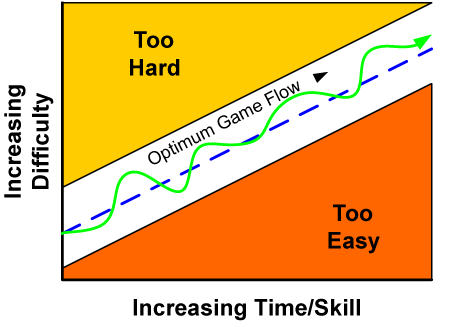
After listening to the latest Brainy Gamer podcast, the topic of setting difficulty level came up as a balancing act for engagement. Too hard and the player gives up in disgust and doesn't enjoy it, too easy and the game is boring with no real rewards. Michael brought in Jesper Juul's Fear of Failing article as a baseline for difficulty setting in modern computer games. It struck me, though, that this kind of engagement through difficulty settings could also help in the broader educational environment, and would be greater achieved through personal learning environments.

Jesper quotes Falstein's work in that difficulty progression isn't just a smooth path either, but comes in waves as the player experiences failure, then adapts and leaps back into success. Maybe little 'Aha' moments all along the journey? I'm drawn to my experience in World of Goo where each level builds on the skills of the previous level, but is not attainable by those skills alone. The problem remains interesting because there is a subtle tweak in the mechanics to allow progression. The engagement comes in finding those tweaks, experimenting with them, and building them into your repertoire for the next level.

Could education be like that too? It smacks of self-directed learning where the student is encouraged enough to seek out answers to the problem by themselves. Maybe the last few questions in maths class should be lead-ins to the next topic? Using previously learned skills COULD get you there if you tweaked the mechanics enough. What happens to those in the class that don't get it? Doesn't seem to fit the teacher-centric model where everyone needs to be at the same level. There is always one strategy that can be used over and over; wait for the teacher to tell you the answer.

When looking at PLEs though, you have the flexibility of delivering the content to people in an individual way so that they can all keep 'in the channel'. Understanding just how much failure is required to make the material engaging would be very appropriate.

'How much failure' is probably the wrong phrase. It's not the measure of intentional failure (you don't set the curriculum to purposely make people fail), but the perceived failure that increases engagement. As long as you know you could have failed. Reminds me of an adage from Sim Golf: "A golf course should look hard, but play easy". The little sims would enjoy the sight of lots of water in front of them, but hate it if the ball went in the drink. A little water or sand placed in the hit-over zones breaks up the course into achievable chunks that made the sims feel challenged, but remain happy.

Juul's GDC talk on Beyond Balancing also indicates that the failure count can be high as long as the failure cost remains low. The failure cost, in this case, is:
Failure Cost = Failure count * Failure communication * Failure setback * Failure repitition
where:
Failure count = number of fails.
Failure communication = ease of identifying why you failed.
Failure setback = how much time and energy the failure cost you.
Failure repitition = how much the task needs to exactly repeated again.
In a personal learning environment these would translate to:
Failure count = Number of attempts to demonstrate the skill (both in a session and over multiple sessions)
Failure communication = Teacher's / curriculum's ability to highlight to the student exactly where they went wrong.
Failure setback = How much time and energy wasted on repeat attempts.
Failure repitition = Whether or not different examples can be used to demonstrate the skill.
Failure also needs to be looked at with a positive attitude. Juul warns against learned helplessness (through attribution theory) where the attitude of the person turns pessimistic. Instead of seeing it as a challenge, they see it as a personal failing. Instead of attempting to do better next time, they give up. Instead of accepting that they may be underperforming in only one area, they see it as total failure. It looks like the psychological effects in an educational context are more grounded, so hopefully that won't be an issue to tackle just through PLEs.


References:

  • Falstein, Noah. 2005. "Understanding Fun—The Theory of Natural Funativity". In Introduction to Game Development, ed. Steve Rabin, 71-98. Boston:Charles River Media.
  • Juul, Jesper. 2009. Beyond Balancing: Using Five Elements of Failure Design to Enhance Player Experiences. GDC conference 09. http://www.jesperjuul.net/ludologist/?p=594
  • Juul, Jesper. 2009. "Fear of Failing? The Many Meanings of Difficulty in Video Games" From Mark J. P. Wolf & Bernard Perron (eds.): The Video Game Theory Reader 2. New York: Routledge 2009. pp. 237-252.

Thursday, April 16, 2009

Jafari Model of PLEs

Reading through a chinese based wiki regarding Personal Learning Environments, I stumbled upon a model that utilised AIs as a core part of the PLE. Not quite the same context as my vision of learning through VR, but it's the first time I've seen a PLE and AI mix. Digging further ...

EDIT: Found the original article that outlines the key points of the new system.

Wednesday, April 15, 2009

Mahara ePortfolio

This year's GDLM 1st years are having to do a combined eLearning and Dimensions of Learning course, part of which is setting up an ePortfolio. I've offered to help tutor for the subject since I really liked the eLearning component last year and it's been pretty fun so far (albeit a bit lacking in time due to work commitments and my own assignments). I'd fiddled with a couple of the ePortfolio systems before, including the Mahara demo, and lamented about the lack of attribution that is currently on offer.

I finally bit the bullet over the weekend and set up my own ePortfolio over at Netspot (CQU shadow system). After using the system for a while it seems a little easier to get around the interface, but the integration to Moodle is the closest thing to attribution I can see. Going to have to dig into how they are doing it to see if there's any fundamental point of validation that can be translated to other web groups/organisations.

Saturday, April 04, 2009

Web 2.0 and Your Own Learning and Development

I've been circling around Stephen Downes' work over the past 2 years while digging into eLearning concepts for my GDLT course. I'm sure I've seen his name on a number of articles and comments, but never really felt the urge to chase them up. Today (gesh, yesterday now, sun's rising) I had a talk to Scot about ePortfolios which lead to my lament about their current state. During my conversation Stephen's name came up again as an example of authority via attribution. Now, during a browse of David Jones' site and following a related link to a connectivism course assignment, Stephen pops up as the course coordinator! Too many coincidences to not follow up, so I checked out his website and stumbled on the very thing I've been trying to get my head around during this past year: PLEs are not just for my future students, they are for me too...


This is awesome! Exactly what I'd been thinking crystallized into a neat package. I'm excited!

Inspired to comment more and link more, here's a rundown of my thoughts on the topics presented in the video:

Not online courses of formal development, but rather how to use the new tools (Web2.0) to enhance your own learning
I've been a little disappointed with the blackboard software used for the GDLT. It offers most of the things that I think I want (linkable content, discussion, grading, peer review), but somehow it does't deliver them in an efficient manner. On the flipside I've found that through more targeted use of RSS, Delicious, blogs and blog comments, I have grown my own network to research this eLearning phenomenon. Bring it on, focus on me!

3 Principles: Interaction, Usability, Relevance
Interaction: For me I'm finding out that I'm more and more a social learner. I want to talk to people and I want to listen to their ideas. One of the courses this year had a tutorial session for on-campus students. The video of this session was far more approachable than the 3 weeks of reading about and around the subject matter, and made a lot of things fall into place. I felt jealous that I couldn't participate fully in a face-to-face session.
Usability: I agree in general about things being useful if they are simple to use and reliable, but not really grabbing me yet.
Relevance: This reminded me of a brief conversation with Ron on the way home from Shed Men tonight regarding how to do effective Google searches. Once you have built up a skill of effective googling (so that you almost always get the exact thing you were looking for as the top link on your search), it changes the way you treat knowledge into facts (retrievable) and application (mashup, analyse/reject alternatives, apply).

Interaction: Human contact, Human content
Exactly! I want to learn, I crave learning. Face to face contact is the best method of getting someone's ideas and perspective from their mind to mine. When we communicate we are always on the lookout for feedback as to whether the receiver is understanding it, or whether you need to explain it from a different angle, or whether you can skip ahead to the next section. Greater interaction breeds faster communication.

Place yourself, not the content at the centre
Lectures relying on a broadcast model is so true. It cuts down on the interaction, but I believe it elevates the human content. It allows the presentation of an idea in a prepared manner, rather than in a fluent conversation. You would hope that the preparation of the content makes it easier to transmit the original concept. I do see exactly what Stephen's talking about though; instead of relying on the content delivery from an educational institution, put in the effort to organize it around you.

I've been feeling recently that my attitude to the GDLT course has gone through just this process. My notion of an academic institution used to be one of an authority without question. They are there to educate; You do the things they tell you to get the piece of paper. That was different to chasing up on my hobbies and interests, even if my hobby was closely aligned to the content at in the course. Placing yourself at the centre rather than the content means that YOU take charge of the direction of learning in the area of interest rather than the direction of the coursework. This difference becomes evident once the coursework is completed. If the content is at the centre of your learning environment then when you replace the content (to do another course) the rest of your learning network goes out the window with it. If you are at the centre of learning the topic, that network can remain even though the coursework is long gone. Life long learning here we come!

Interaction: Your personal network
Lots of tools to use for setting up your personal network. Most of them I use already to a greater or lesser extent. I think the key here is the purposeful use of the tools to create a learning environment rather than just a social medium.

An example is RSS. I have used RSS in some form since it's inception, but mainly from backend processing. I knew of RSS readers and their capabilities, but never really found them to be all that useful because not every page supported RSS. This undermined the intention of a reader to be the main point of contact with the net. During last year I set up Google Reader to start aggregating websites I found interesting for the GDLT course. It took about 6 months before I noticed a change in my perception of Google Reader. Instead of being a tool to track websites for the course (since I was no longer doing that subject), it became a tool for tracking my areas of interest. The trick is to follow smart people that challenge you to think. This purposeful use of the technology transformed it from a tool for delivering content to you, to a place where I'm challenged to learn every day.

Interaction: Pull is better than Push
To me this is the key to engagement learning. If you can convince someone that they need to seek out the answer, they are much more receptive when the answer is provided. Pull means they have a need for the information, whereas push may or may not hit the mark of what they were expecting to learn.

Interaction: Speak in your own voice
I've certainly known for a long time that I can communicate more effectively face to face, or failing that, a phonecall. I've tried doing podcasts etc, but Stephen gives me more conviction that I should be trying harder to communicate via voice, especially recording voice instead of just sitting here typing it down.

After Showing Sandy the first part of this article and illustrating how she could use web2.0 to construct a PLE around Digiscrapping, I also indicated that she could be recording her own thoughts about how she made each piece to potentially help others. In reply to the answer "That'd be too long!", I thought that voice recording would be an alternative with a paragraph or 2 as a summary for the blog. Reflective learning and all that.

Interaction: Share your Knowledge
I like the sentiment, but I think that a lot of people (like Sandy) feel that there's no point in sharing because nobody with find value in what they have to say. I know that when I started this blog there was no real desire to be famous or to publish, but just to get my thoughts down somewhere searchable (and to practice typing). It reminds of a quote I heard at the start of one of the subjects this year that "any data is useful if it can be managed" (searchable, taggable, mashable).

Interaction: Make it a priority / habit
Yes, something I need to do better. I'm just starting out in validating the process in my own mind, but the procrastinator in me is going to be a lifelong enemy...

Interaction: Guerilla Tactics
Yeah baby! This is really the clincher for me. Why bother whinging about the lack of interaction on Blackboard when you could easily set up a wetpaint / wikispaces / ning group and launch off again. I think it's still a hangover from sitting back and expecting the Uni to take the lead.

This year I went to the Reso college with a direct need to set up partnerships with other students or a Bundy study group. 2 months later I still haven't talked to anyone apart from the Blackboard forums, so I'd say that I'm failing at guerilla warfare so far. Maybe I need more conviction to take the lead in setting up my own support group, or maybe others either don't have the knowhow to take the initiative, or maybe they don't care? I doubt any of the first year's would have had the same determination as I did at the start of the year (not knowing what's on offer), or have the technical knowhow that I do on all the Web2.0 technologies, or have the interest to search out things like this video, so maybe Guerilla warfare is a LOT harder than it sounds...

Usability: Consistency, Simplicity
As a contract programmer there are some basic interface tenets behind these 2 elements. A good user interface shares a lot of the properties of communication tools because they are trying to achieve the same thing: to let the information flow. You should be able to intuitively do what you want, when you want. A good usable tool facilitates this, rather than getting in the way.

Usability: Summarize, summarize, summarize
Back to that quote again. All data is valuable once it is in a manageable form. Summarizing makes the data more valuable by providing even more context for searchability & mashability. Delicious does this with aplomb as it is trivial to tag multiple relevances according to what others have already tagged it, or your own personal take, or your own comments. It all depends on exactly what you want to remember it by / communicate it by and your care factor. If you don't care that much about tagging it's still dead simple to +d, click, click, click and you're done. All the effort of adding value is taken away so that it increases the perception of worth once you start relying on the data down the track.

Usability: Guerilla Tactics - Your institutional CMS is almost certainly dysfunctional
Ahahahahaha! My thoughts exactly. All the bits, but somehow it just doesn't work. Definitely a usability issue.

Blogging: The people who talk about blogs as publishing, they're the ones getting it wrong
Well, I certainly agree with the sentiment that a blog is simply a place for notes, but I think organized blogging also has its place. They've hijacked the medium and made it something different, but I don't think they are wrong in doing that.

Flickr: They have creative commons licensing
Never really used Flickr because the pictures I wanted to share are easier / more contextual inside a blog post. Didn't know that you can tag a photo specifically for CC use though, that might sway me right there.

GMail: Create a gmail account and forward important mails to it
I'm finding that it's even more useful to have multiple gmail accounts for backing up different mail addresses, then filtering them through to one account for display / regular mail use. Best thing about gmail is the spam filtering and the archiving. Hotmail recently released pop3 support so that will be one of the last emails to be integrated into the system. The one remaining is my university account that only seems to have IMAP support. Need to look for an IMAP to pop pipe...

Google Desktop
Tried using it when it came out, but it still impacts too much processing time compared to the once-a-month search I needed it for. With more and more things going to the web I see this is less and less as a needed tool. Seemed like a good idea though...

Relevance: Getting what you want - RSS
Agree now, but there are still webpages that don't have RSS. I'm still looking for an RSS subscription for Stephen's daily newletter. It might be there, but it's not obvious yet. (and no, I don't want to subscribe by mail if I can help it, it's part of my primary learning environment, but my chore basket for work)

Edit: I take all that back, not only did I find Stephen's feed sitting on the main page, but subscribing wasn't working because it was already in my list kinda feel really foolish now.

Google reader definitely comes into its own once you have more than around 50 feeds, but my unread postcount will forever stay at (1000+). I've even had to make a "_critical" tag for feeds that I absolutely must check each time I'm logging on, regardless of the different fields of interest that I have.

Relevance: shun formal classes
I've had this urge to do almost exactly that. A couple of the comments and thoughtful discussions I've had have been in Blackboard forums. If I want to link to these now or refer to them 5 years later I can't because that information is locked up in a closed system. I'm in the process of putting together an ePortfolio and am keen on using it to replicate assignments / poignant discussions for future relevance. That or plonk it on here, which was my first thought before getting fired up on ePortfolios.

Relevance: Demand access
I really don't like demanding, why not request it? Where'd common courtesy go? I'm a systems admin and if someone presented a valid arguement why they feel they need a certain technology then I'd most likely agree unless there are factors that they have not considered. Shadow systems and backchannels are all well and good, but demanding you purposely subvert the system is a little much.

You are at the centre of your own Personal Learning Network
Check.

To gain from self-directed learning you must be self-directed
I'm dawning on the idea that the purposeful construction of your own network to follow challenging ideas is the key to self-directed learning. I know I'm self-directed in my own social network and I'm involved in formal learning, but this makes the link between the two for me.

These principles should guide how we teach
It's a little scary thinking that, as a prospective teacher, kids will demand what whey want to learn next. Does every child have the discipline to know what they want? To do the English studies instead of the ball sports? In my vision of a virtual learning environment, each student will have a learning manager assigned to them (guidance officer?) that helps them build a learning plan through the units available with the knowledge of parental desires, societal desires, societal needs and the kid's personal preferences. Not exactly self-directed, but as much self-direction as possible.

Hopefully the upshot is increased engagement. If the student feels in control of their learning network, they are the ones looking for answers and ready to be lifted to the next level.

Friday, April 03, 2009

e.Portfolio Attribution

We're now looking into e.Portfolios for the GDLT course as a way of documenting our learning journey and a step toward an ICT Pedagogical License. Scot has recommended Mahara, an ePortfolio system coming out of the New Zealand higher education system, or possibly WetPaint in a roundabout way.

The problem I see with both of these systems (and also the Moodle and Sakai implementations) is that they are light on the attribution from others. It's all well and good to just write up a resume' about all the wonderful things you did, but with an ePortfolio you have the ability to interact with the institutions and organizations providing accreditation in a direct sense. Here's a vision of what I'd like to see in an ePortfolio:

The Vision
I want to be able to write a document about a certain topic and link it to my ePortfolio (either by directly hosting it in the ePortfolio system or linking to its original point on the net). I then want to make this artifact available for others in a group, or individually, or publically. Then I want others to be able to comment on the document, respond to the document with a document of their own, or rate the document (like a kudos in Slashdot). Rating relies on the authority granted to the person doing the rating. Anyone can rate anything, but the more influential the voter the higher its significance. If the document is for contribution to a group, the group moderator (or a consensus of the group) can give a group rating instead of an individual rating. This means that the group itself has attributed this article worth rather than an individual voice. This can be extrapolated to more and more official 'groups', such as submitting a document as an assignment for a University course with the course moderator (eg: lecturer / marker) attributing a rating on behalf of the course itself, or combining multiple grades from different courses to give a certificate by the University.

Ownership of Attribution
As with kudos or comments, the ownership of the attribution stays with the originator. So if someone makes a comment on your document they still retain ownership of those comments, but grant the recipient the right to display that comment alongside the article as an attached artifact. Even giving a rating is still attribution and retains the ownership to the rating giver, but transfers the right to display the attribution alongside the document.

Validating Attribution
Collected ratings could also be used to develop another view demonstrating achievement in a certain discipline. Instead of writing up a Curriculum Vitae as a static web page or a collection of personally typed text, each achievement is automatically able to be validated by following the attribution back to the giver. Even if the attribution is a summary of multiple achievements, it should be possible to provide a view to those achievements built by the summary maker, giving a chain extending right back to the material that demonstrates each facet of the overall achievement.

A Framework of Achievement
With an expedient method of attribution and an easy method to validate the attribution givers, you could construct a framework of course units where each unit requires a set of demonstrated skills for acceptance, and provides a set of demonstrated skills once completed through attribution. Once an established framework of units are tied simply to the existence of demonstrated skills, it allows multiple units to operate in parallel to deliver those skills, but potentially change the method of delivery.

Imagine a unit for trigonometry where it is designed with graphs and diagrams aimed at visual learners running alongside another unit with a more verbal, story centred approach. Both could deliver the same demonstrated skills (achievement in trigonometry) but give the learner the flexibility of choosing their preferred path of learning. If, through the course of one unit the student is creating artifacts that demonstrate another discipline, those artifacts can be presented through another view as prior learning evidence once they take on the new discipline.

Breaking down the Barriers of Authority
Although it may seem that the authority required for official attribution would be prohibitive, the ability for anyone to grant attribution means that more can be done with peer relationships and semi-authorative sources. Peers in the same unit would be encouraged to comment and rate other people's documents as part of a reflective process. These peer ratings can help guide an authorative source, or even provide enough weight on their own for unit completion. People who have already completed the unit confer more credibility with their rating, which gives rise to a mentor / tutor position of attribution. This not only helps the pupil, but may establish an easy channel for people to become authorative sources in their own right. Through correct ratings and comments, a mentor can demonstrate a higher level of critical thinking that can in turn gain attribution of excellence in the subject.

Attribution by anyone also opens up the possibility of groups with no known authority developing their own layers of authority through meritocracy. An example of this would be Flickr where, through attribution, people's photos are ranked in many different ways. If someone gains a following through good photos, they can carry more authority when attributing a positive comment on another's photo as many more people will also then look at that photo. At a layer up, groups have spontaneously formed where their authority is purely on the strength of the service they provide to their members in finding pictures that fit the group's criteria.

Back to Reality
Somehow this ePortfolio system mashed its way into my vision of virtual reality. I guess that's a good thing as I've been wondering what the first steps could be to implement such a system. As a starting point though, I feel it's definitely worth the time collating all the documents, blog posts, web sites & videos that I have been given official attribution for already (read: Uni assignments). I doubt I'll be able to get the original attributers to give a digital attribution, but I could make placeholder artifacts until that day arrives.