Firstly the news: I've accepted a position at St Luke's as a full time teacher next year. Mainly IT subjects, but a little splash of maths too.
To prepare for next year, I'll also be putting together a work program for 11/12 IPT as the syllabus for 11 has changed this year. It'll most likely change again next in a couple of years when the national curriculum comes in, but we'll tackle that one when it comes. So, for the next couple of research Thursdays I'll be reviewing the syllabus and sample work programs to try to build a work program that doesn't restrict all the things I have in mind.
First up is a work program for teaching a composite class with the same content. I'd wondered if that was possible because the current composite class has effectively 2 different subjects being taught at once. It's possible by designing a largely self-driven learning environment, but it would seem more appropriate in keeping both classes on the same subject, just modifying the assessment for either 11 or 12.
Lots of reading, lots of decisions ...
Showing posts with label GDLT. Show all posts
Showing posts with label GDLT. Show all posts
Thursday, November 04, 2010

Thursday, November 12, 2009
QCT professional Standards
Updated my ePortfolio to cover the 10 professional standards of the Queensland College of Teachers.
Final week of prac and then I'm a teacher!
.. although it's only a provisional license, and I'll probably lose it because I doubt I'll get 200 days teaching done.
Final week of prac and then I'm a teacher!
.. although it's only a provisional license, and I'll probably lose it because I doubt I'll get 200 days teaching done.
Monday, September 21, 2009
Intern rollercoaster
Signs you've been playing too much rollercoaster tycoon:

Thursday, September 10, 2009
Assessment and Reporting Tutorial
Writeup of A&R Tute on 6/9/09. Now I just need to find somewhere to upload the actual audio.
- 0:45 Describe portfolio.
- 1:20 Comparability of work
- 1:50 200-400 pointscale
- 2:40 reflect the gaps rather than concentrate on getting the right rung
- 4:10 Expectations of pre-service / 1st year teacher for ranking student
- 5:20 QCAT standards for assessment bank items to be ramped up
- 6:50 Nearly Everyone sits the tests
- 7:50 Naplan results, 2nd last for Qld
- 8:45 Contextual assesment vs standalone tests
- 9:30 Building the IPT course
- 10:50 Making criteria sheets for 'A level' standard
- 11:40 Make sure you teach what you assess
- 12:10 Progressive scale of assessment
- 12:45 'Fullest and Latest'. Key principle of assessment
- 12:55 Don't simply add up the scores, use quality of material.
- 13:10 Used at panel. First assess the quality of material
- 13:50 Intentionally Hard
- 15:10 Discernment of knowledge through assessement rather than task completion.
- 16:00 80% for demonstration of mastery
- 17:00 Core Skills Test
- 17:55 Best of its type
- 18:20 Purpose - Give the student a grade on an A to E scale. C is acceptable for Lit/Num minimum
- 19:00 How many sit the test
- 20:10 Purpose - Scaling one school against another.
- 22:10 Pressure as a senior teacher to pass students rather than failing them
- 23:00 50% students well serverd by school today, 30% suffice, 20% want out
- 24:20 Schools aren't the same. Wide variety of cohorts and school direction
- 26:00 Design parameters of the QCS test
- 27:00 assessed 35 syllabuses analysed for ~60 common curriculum elements
- 29:00 Current CCEs
- 29:30 Some CCEs are performance based that can't be tested by paper, leaving 49 CCEs
- 30:10 5 big baskets of CCEs
- 30:20 Each year they don't test all CCEs, but only about 1/2 of them and rotate through them each year.
- 33:00 Navigation to Core Skills test website
- 33:30 Difference in CCEs
- 36:00 QCS test can be hard.
- 37:00 Multiple choice shouldn'thave dummy answers, all should be accptable, but one the most appropriate.
- 37:30 layout of multiple choice questions not needed to be shortest to longest
- 38:40 Language of QCSTest. Short and Sharp. Lower level language used than the core skills it attempts to test.
- 40:30 Design of NAPLAN questions: round table -> UNSW
- 41:30 Security of tests, security leaks
- 42:00 Structure of QCS Test: Short Response, 2xMultiple Choice and Writing Task
- 42:30 Testing for Equity in questions before it is sent out for use.
- 44:00 70% pass rate is a good number to aim for in general
- 44:20 Cost of QCS Test
- 44:50 New teachers mentored into the system through moderation (Professional Development)
- 47:00 Preparing for the test
- 48:00 'Test wize': How the test looks, the language, the types of questions, the time it takes to achieve.
- 48:30 QCS test design Easy ones first, might end with hard one, but not mandatory to be scaled linearly.
- 49:50 Unspeeded tests? When do we have time critical assessment in the real life?
- 50:50 Expected to be completed in 2/3rds the time allocated.
- 51:20 Review of sample question and criteria sheet for marking
- 52:30 Difficulty of question for 1 to 5 stars. Shown on test.
- 53:20 Questions weighted, but more for the expected time taken to answer rather than pure difficulty.
- 54:30 Review of sample question and criteria sheet for marking
- 56:30 Review of writing task
- 59:50 Bottom line: Best preparation for a test is do do a similar one.
- 1:00:00 Immediate quality feedback
- 1:08:00 Summative assessment runs counter to immediate quality feedback?
- 1:30:00 So many pedagogy methodologies. Which to choose? DoL, QSA.
- 1:35:00 DoL aligns to teacher best practice.
Thursday, July 23, 2009
Full Immersion 2025 - A vision of the future
Wow.
A casual Diigo link to the Colorado Virtual Academy this afternoon had me interested. I'm always on the lookout for virtual learning environments that match my ideas of the way to the future, and this link just kept ticking the boxes.
First off I noticed "An individualized approach to learning". Now that term has been bandied about a lot recently without really any substance to it, but paired with a virtual environment it is possible and a main goal of my VR dream .
A bit further down the page and another cathphrase pricked my ears: "An ideal fit for accelerated learners". Having completed an assignment last term on how to manage gifted and talented students in the current curiculum and also the implications of accelerated learning in a VR environment, it seemed likely that we might be on the same wavelength.
Digging into the accelerated learners section confirmed my suspicion: "The K-8 curriculum is mastery-based, enabling students to advance when they're ready—not when the rest of the class is." Wow. First time I've seen that type of thought expressely used in an established learning institution. I'm excited!
Looking deeper into the K-8 curriculum I find another component of my model: "And with more than 700 lessons per subject, he can dive deeply into areas of interest." Yes! A curriculum exploded into bite size chunks. No real indication of a meshed list of prerequisite skills, but nothing to the contrary either.
Opening up the individual courses it starts to sound more like an ordinary school approach. I got excited that "From helping younger students make the link between the concrete and the abstract to introducing older students to Algebra" might mean having an intrinsic peer mentoring approach, but upon reading it again it's really just showing the breadth of the whole course.
A phrase appeared a couple of times that didn't really make much sense: "Big Ideas + Consecutive Down Payments + Practice = Mastery". Found out a little later on that the downpayments are the stepping stones to the big ideas. Makes more sense now and shows the benifits of an adaptive curriculum.
Through tea I was really excited on how close it matched my model. The closest by far. I dug up a blog of Bror Saxberg for my google reader and the first article caught my eye: "A vision of the future", where he expands on his participation in a published article on how 10-year olds will learn in 2025. This article is amazing! It's like reading something I would have written myself. Our visions of a future educational environment through VR are almost identical!
I really like the implementation of the helper AI (yoda). I'd dumped most of the AI elements from my model as I wanted it to be as believable as possible to the Uni lecturers I was presenting the model to without having to explain the intricacies of tracking AIs, shadow AIs, Tutor AIs and helper AIs (which was a big part of the vision in my early days; I guess that's because AI was a big hobby for me back then). I still think that a yoda helper AI is still further off than 2025, but then again it depends on the scope of something like Project Natal. Having AI's able to learn standard answers from real teachers and tutors would then be able to fill in forums / FAQ sessions in the absence of a real tutor. I had always envisaged helper AIs saying things like "You answer is most likely ..." to give the relative confidence to the learner on the veracity of the answer given, and being able to show the pieces of information that made that assumption if questioned.
For me the big part for AI's to play is through "shadowing". For every student you have a shadow AI that attempts to emulate the thought processes of the student. It tries to predict what questions the student will get right, what they get wrong, etc. With those "aha" moments in learning where the patterns and processes finally click into place, there will be a big positive spike in the error between the shadow AI and the student. This can be used to trigger the next phase of learning. The shadow AI can also be used for system wide testing, where it can be interrogated and compared to other student's AIs for help in choosing the next course to take. Bror's vision seems very close, but relying more on the student's actual results to make the system learn how to educate that student better.
The role of educators in both systems seems very much inline. I think that through the Uni course I'm concentrating more on allowing different learning styles to be catered for through the variety of courses on offer to achieve the same skillset, whereas Bror focuses more on deep database analysis.
Deep database analysis is one area where Bror's model seems more advanced than what I had imagined. His use of data mining techniques to shape the curriculum seems more solid than the shadow AI approach. Both systems would compliment each other though; shadow AIs would just give more data for analysis.
So pleased that I found this link and Bror's ideas. I'm over the moon that someone has demonstrated what I'd been contemplating for a long time. Well, not everything's implemented yet, but with someone at the helm with such a closely aligned vision I can see exactly where the boat is going...
I want on ...
Monday, June 22, 2009
GDLT Signing ... on ?
2 days.
A glorious 2 days to really get back to what I was missing in life. Games, beach walks, playing with Cameron and Rachael... I really thought I'd made the right decision to drop out of the GDLT.
When I got back to work on Tuesday, I phoned in to the uni to let them know of my desicion, but the more people I told the more resistance I felt coming back at me. " It's only another 6 months!", "It'll open up lots of doors!", etc. I'd considered all that, but the real clincher was information regarding the only real avenue for teaching I was looking forward to.
2 days...
I rung up Ricki and laid out the issues again, and he granted me more extension time for the 2 outstanding assignments than I was expecting. It all seemed achievable again. Now, after 2 weeks have passed and both assignments are in I can relax. Well, for 4 days I can until reso school starts again.
Ended up pretty happy with the Supportive learning assignment once I decided to ignore what the Uni would think of a well constructed classroom management plan and really just outline what I believe to be a fair reflection of my views on behaviour management and supportive learning environments in general. The management plan is presented as a classroom covenant between the students and the teacher where each sides promise to do an action to gain the action from the other party (EG: The teacher promises to create the safest environment they can, and in return the students promise to not intentionally put themselves or others in harms way). These reciprocal arrangements demonstrate practical examples of how to deliver the rights, responsibilities and respect needed for a properly functioning classroom.
On the flip side the Literacy and Numeracy report became more and more a hard slog. I was pretty ropable that the previous assignment word limit of 2000 words was more like double that in the examples, and I got pinged for brevity when the whole assignment was over 3000 words :(. This one was expected to be 3000 words, whereas some examples are pushing 70 pages! Every time I think about it makes me mad. In the end I just made the decision that whatever state it's in when I needed to drop it off is what I'm going to submit. Bits were missing but frankly I don't care. Nearly 5000 words and I know I'm going to get pinged for brevity again :/.
4 days ... 4 days to enjoy being me before it all starts again. I need another pep talk ...
A glorious 2 days to really get back to what I was missing in life. Games, beach walks, playing with Cameron and Rachael... I really thought I'd made the right decision to drop out of the GDLT.
When I got back to work on Tuesday, I phoned in to the uni to let them know of my desicion, but the more people I told the more resistance I felt coming back at me. " It's only another 6 months!", "It'll open up lots of doors!", etc. I'd considered all that, but the real clincher was information regarding the only real avenue for teaching I was looking forward to.
2 days...
I rung up Ricki and laid out the issues again, and he granted me more extension time for the 2 outstanding assignments than I was expecting. It all seemed achievable again. Now, after 2 weeks have passed and both assignments are in I can relax. Well, for 4 days I can until reso school starts again.
Ended up pretty happy with the Supportive learning assignment once I decided to ignore what the Uni would think of a well constructed classroom management plan and really just outline what I believe to be a fair reflection of my views on behaviour management and supportive learning environments in general. The management plan is presented as a classroom covenant between the students and the teacher where each sides promise to do an action to gain the action from the other party (EG: The teacher promises to create the safest environment they can, and in return the students promise to not intentionally put themselves or others in harms way). These reciprocal arrangements demonstrate practical examples of how to deliver the rights, responsibilities and respect needed for a properly functioning classroom.
On the flip side the Literacy and Numeracy report became more and more a hard slog. I was pretty ropable that the previous assignment word limit of 2000 words was more like double that in the examples, and I got pinged for brevity when the whole assignment was over 3000 words :(. This one was expected to be 3000 words, whereas some examples are pushing 70 pages! Every time I think about it makes me mad. In the end I just made the decision that whatever state it's in when I needed to drop it off is what I'm going to submit. Bits were missing but frankly I don't care. Nearly 5000 words and I know I'm going to get pinged for brevity again :/.
4 days ... 4 days to enjoy being me before it all starts again. I need another pep talk ...
Monday, June 08, 2009
GDLT Signing Off
EDIT: Not any more ...
Studies this year have been kind of odd. I have solidified my views on a learning environment of the future, helped Scot with an eLearning course I completed last year, and have developed my own sustainable Personal Learning Environment. All this with little or no input from the 2 subjects that I actually took this year. Supportive Learning Environments triggered a number of lively debates regarding "the right to an education", but overall felt a little too politically correct for my continued enthusiasm. Literacy and Numeracy had some practical models to follow, but didn't really grab me.
Assignments. Another reason to pull the plug. My grade 7 teacher introduced me to an interesting concept; homework was what you didn't finish in class. To me that was brilliant because I could really apply myself and get everything done in school time to have no homework at home. I continued this mentality throughout high school and by Uni I'd become an expert in not having work to take home. I purposely chose subjects with a greater than 70% final exam so that I didn't have to bother with assignments. With this course being 100% external and ~100% assignment based, it was rubbing me up the wrong way. Having 2 unfinished assignments hanging over me probably helped with the decision.
Teaching was way easier than last year, and with the flexibility to deliver my unit and webquest developed last year, IPT (especially 10 IPT) was a lot of fun. On the flip side, the maths subject felt constraining and stressful. With no wiggle room in the curriculum to do anything but the prescribed text, it felt like you were always pushing and pushing to get the work done. There was hardly any room to develop PLEs or classroom2.0 technologies.
Maths also exposed me to an issue I knew I didn't want to deal with; teaching students who didn't want to be there. I remember back in highschool when I first started thinking about becoming a teacher that senior (11,12) was way better because of this fact, only to be trumped by the uni philosophy a couple of years later. After a couple of talks with Bernie and Nick I realised that there would be very little likelihood of teaching only senior if I were to enter the general teaching population, so I know for sure that I'm NOT going to be a full time school teacher. That wan't my plan on starting this course; I was more thinking of being a supply teacher for St Luke's, but with IPT being the only thing I'd be interested in teaching, I'm basically cover for Nico if he ever got sick.
The volume of work in the course is also an issue. Even though it's been sooo much easier in 2nd year than last year, for the last month it's felt like I'm doing nothing but coursework, teaching and work. I knew my gaming would suffer, but it's virtually been non-existent as well as having to skip other regular events. I've missed being me.
So in the end the decision seemed pretty obvious; why bother doing something that the outcome is getting less and less desirable? The costs are outweighing the next 6 months of learning and the piece of paper on completion. In fact I'm not looking forward to the 6 week prac. I'd rather just work.
So what now? One of the pressures keeping me in the course is that it's safe. It's a decision I've made and it provided me with a framework of what to expect for the next 6 months. Now I need to deal with an uncertain future.
Upon reflection of the whole course, I'm glad I did it. I've learned a whole lot more about teaching through the course, as well as developing my own PLE, unearthing ideas from the past that are only now able to be implemented, being exposed to David's and Stephen's philosophies on summarizing thoughts for your own use, and generally taking eLearning issues more seriously. I'm still keen on pursuing some sort of teaching career, just not in a school. Uni's are still firing people rather than hiring, so that's still out. Maybe VET? I'd be much more confident going into the TAFE position I was interviewed for before starting with St Luke's. Hopefully there'd be a lot of concessions in a Cert IV from all the prac and study I have done. I'll need to research a bit more about the positions available and what feels like the best fit.
A big thing to take away from the course is my own personal development. I'd really like to continue following topics such as PLEs, games in learning, VLEs/CMSs, etc and hope to put at least 2 hours a day aside for personal learning, reviewing and contribution. Even focusing on things like Brainy Gamer and LO3 can keep the professional discourse going in other areas of my life.
With more dedication to summarizing and analysis, I'm also thinking that I'll need to learn touch typing; something I've put off for 25 years. I'm still hoping that voice communication would be ubiquitous at some point, but with things like Google Wave on the horizon, it's going to be at least 5 years before voice gains an appreciable foothold. It'll certainly be handy for the AAR Fiction stuff too.
In summary, plans for the future:
- Investigate VET
- Investigate Teacher training positions in eLearning
- Commit 2 hrs a day for PD
- Learn touch typing
- Revisit PhD work
Big list for a procrastinator...
EDIT: Not any more ...
Studies this year have been kind of odd. I have solidified my views on a learning environment of the future, helped Scot with an eLearning course I completed last year, and have developed my own sustainable Personal Learning Environment. All this with little or no input from the 2 subjects that I actually took this year. Supportive Learning Environments triggered a number of lively debates regarding "the right to an education", but overall felt a little too politically correct for my continued enthusiasm. Literacy and Numeracy had some practical models to follow, but didn't really grab me.
Assignments. Another reason to pull the plug. My grade 7 teacher introduced me to an interesting concept; homework was what you didn't finish in class. To me that was brilliant because I could really apply myself and get everything done in school time to have no homework at home. I continued this mentality throughout high school and by Uni I'd become an expert in not having work to take home. I purposely chose subjects with a greater than 70% final exam so that I didn't have to bother with assignments. With this course being 100% external and ~100% assignment based, it was rubbing me up the wrong way. Having 2 unfinished assignments hanging over me probably helped with the decision.
Teaching was way easier than last year, and with the flexibility to deliver my unit and webquest developed last year, IPT (especially 10 IPT) was a lot of fun. On the flip side, the maths subject felt constraining and stressful. With no wiggle room in the curriculum to do anything but the prescribed text, it felt like you were always pushing and pushing to get the work done. There was hardly any room to develop PLEs or classroom2.0 technologies.
Maths also exposed me to an issue I knew I didn't want to deal with; teaching students who didn't want to be there. I remember back in highschool when I first started thinking about becoming a teacher that senior (11,12) was way better because of this fact, only to be trumped by the uni philosophy a couple of years later. After a couple of talks with Bernie and Nick I realised that there would be very little likelihood of teaching only senior if I were to enter the general teaching population, so I know for sure that I'm NOT going to be a full time school teacher. That wan't my plan on starting this course; I was more thinking of being a supply teacher for St Luke's, but with IPT being the only thing I'd be interested in teaching, I'm basically cover for Nico if he ever got sick.
The volume of work in the course is also an issue. Even though it's been sooo much easier in 2nd year than last year, for the last month it's felt like I'm doing nothing but coursework, teaching and work. I knew my gaming would suffer, but it's virtually been non-existent as well as having to skip other regular events. I've missed being me.
So in the end the decision seemed pretty obvious; why bother doing something that the outcome is getting less and less desirable? The costs are outweighing the next 6 months of learning and the piece of paper on completion. In fact I'm not looking forward to the 6 week prac. I'd rather just work.
So what now? One of the pressures keeping me in the course is that it's safe. It's a decision I've made and it provided me with a framework of what to expect for the next 6 months. Now I need to deal with an uncertain future.
Upon reflection of the whole course, I'm glad I did it. I've learned a whole lot more about teaching through the course, as well as developing my own PLE, unearthing ideas from the past that are only now able to be implemented, being exposed to David's and Stephen's philosophies on summarizing thoughts for your own use, and generally taking eLearning issues more seriously. I'm still keen on pursuing some sort of teaching career, just not in a school. Uni's are still firing people rather than hiring, so that's still out. Maybe VET? I'd be much more confident going into the TAFE position I was interviewed for before starting with St Luke's. Hopefully there'd be a lot of concessions in a Cert IV from all the prac and study I have done. I'll need to research a bit more about the positions available and what feels like the best fit.
A big thing to take away from the course is my own personal development. I'd really like to continue following topics such as PLEs, games in learning, VLEs/CMSs, etc and hope to put at least 2 hours a day aside for personal learning, reviewing and contribution. Even focusing on things like Brainy Gamer and LO3 can keep the professional discourse going in other areas of my life.
With more dedication to summarizing and analysis, I'm also thinking that I'll need to learn touch typing; something I've put off for 25 years. I'm still hoping that voice communication would be ubiquitous at some point, but with things like Google Wave on the horizon, it's going to be at least 5 years before voice gains an appreciable foothold. It'll certainly be handy for the AAR Fiction stuff too.
In summary, plans for the future:
- Investigate VET
- Investigate Teacher training positions in eLearning
- Commit 2 hrs a day for PD
- Learn touch typing
- Revisit PhD work
Big list for a procrastinator...
EDIT: Not any more ...
Thursday, June 04, 2009
Google wave presence
Scott Wilson presented an interesting talk about presence and how the internet currently services these different aspects. In response to his comment about how Google wave is going to handle presence, I got 1/2 way through writing a response before realizing there's a diagram I could use to highlight the different points:

I've roughly coloured the slide with green for sections implemented in the current video, blue for where I think they'll want to be for release through integrating user's to google accounts, yellow for a harder implementation, mainly because it will rely on manual updates until the orange sections come online. It's alll possible with today's technology, but the strength of google wave's presence (as an email/IM replacement) will remain purely through a sense of activity.
Back to the question at hand about Google wave's ability to handle compartmentalisation, and I'm drawing blanks as to the most efficient method to implement it. The one technology that really had no issues with compartmentalisation was email as there was no presence to begin with apart from a diluted sense of activity. There was virtually nothing tying one email conversation to another apart from the time to respond. Once IM-like features are added into wave though, it feels like there should also be communication availability settings too as an adjunct to the immediacy of the conversation. Communication availability brings a much tighter bond between the waves though, and thus increases the issue of compartmentalisation.
Maybe the issue of availability can be broken down into separate specific goals? Availability can enhance the sense of activity by identifying to others when the user is focusing on their specific wave (not the wave client or the wave container). That would seem fairly simple using the 'wave reader' model where only one wave would typically be open at once, but what about a blog with 5 waves on the same page? IRC and IM have long forgotten the 'one conversation at once' mentality, so I would anticipate that even readers themselves would eventually have the capacity to follow multiple waves at the same time. Would writing in one wave indicate a loss of focus of the user on the other panes? Not necessarily.
When dealing with self-expression and facilitating casual interaction, compartmentalisation will really start to stick out. You want to have a cool looking icon for your buddies to see, but it may not be appropriate for the workplace. If waves replace forums, how many profiles would you have aggregated back to your wave reader? A status update might be possible to divert to a new wave sent to your 'distribution list', but that sounds messier. I'm not a big status setting person anyway, but one of the main factors is the simplicity of the action.
Maybe it's time we all donned a single identity? Maybe. Maybe it is part and parcel of who we are to express ourselves differently depending on the context and participants of the conversation? Maybe we just have multiple wave identities like we have multiple email and IM accounts? Lets hope not as I'd dearly love to have only one place to check ...

I've roughly coloured the slide with green for sections implemented in the current video, blue for where I think they'll want to be for release through integrating user's to google accounts, yellow for a harder implementation, mainly because it will rely on manual updates until the orange sections come online. It's alll possible with today's technology, but the strength of google wave's presence (as an email/IM replacement) will remain purely through a sense of activity.
Back to the question at hand about Google wave's ability to handle compartmentalisation, and I'm drawing blanks as to the most efficient method to implement it. The one technology that really had no issues with compartmentalisation was email as there was no presence to begin with apart from a diluted sense of activity. There was virtually nothing tying one email conversation to another apart from the time to respond. Once IM-like features are added into wave though, it feels like there should also be communication availability settings too as an adjunct to the immediacy of the conversation. Communication availability brings a much tighter bond between the waves though, and thus increases the issue of compartmentalisation.
Maybe the issue of availability can be broken down into separate specific goals? Availability can enhance the sense of activity by identifying to others when the user is focusing on their specific wave (not the wave client or the wave container). That would seem fairly simple using the 'wave reader' model where only one wave would typically be open at once, but what about a blog with 5 waves on the same page? IRC and IM have long forgotten the 'one conversation at once' mentality, so I would anticipate that even readers themselves would eventually have the capacity to follow multiple waves at the same time. Would writing in one wave indicate a loss of focus of the user on the other panes? Not necessarily.
When dealing with self-expression and facilitating casual interaction, compartmentalisation will really start to stick out. You want to have a cool looking icon for your buddies to see, but it may not be appropriate for the workplace. If waves replace forums, how many profiles would you have aggregated back to your wave reader? A status update might be possible to divert to a new wave sent to your 'distribution list', but that sounds messier. I'm not a big status setting person anyway, but one of the main factors is the simplicity of the action.
Maybe it's time we all donned a single identity? Maybe. Maybe it is part and parcel of who we are to express ourselves differently depending on the context and participants of the conversation? Maybe we just have multiple wave identities like we have multiple email and IM accounts? Lets hope not as I'd dearly love to have only one place to check ...
Tuesday, June 02, 2009
Google Wave - a saviour to fragmented conversation
22 minutes in to the Google Wave demo and I see the massive impact this is going to have. I recently wrote up a comment on Sue Waters' blog regarding the reasons why Twitter is not better than comments, but it changes the conversation due to massive fragmentation (well, twitter is the not the only culprit, but without trackbacks it expedites dispersion of the conversation). Now, with wave, we can have the best of both worlds: An easy method for containing and collating the conversation, but allowing the freedom to access the conversation at your leisure using the tools that you want. It's the philosophy of RSS, but applied to the whole conversation.
You know what this means? Death to twitter. Life to blogs as conversation starters!
Your wave reader will totally replace the RSS reader as it gets around that messy issue of checking separate RSS threads for comments, or missing a jump in the conversation over to a new blog. Hoorah!
25 minutes in and the death toll rises. SMS can disappear forever! Unfortunately it also means that I'll have to seriously think about a data plan for my next phone as well as wireless.
29 minutes in and I'm now regretting spending 2 hours last night setting up a Diigo account instead of working on my assignment. Actually why am I wasting more time typing this up? Deep down I know why; I'm excited. I'm researching stuff and learning through my PLE and I'm enjoying it.
30 minutes in and playback now reminds me of a wiki history, but in a much more simple and elegant interface. I'm liking it!
I like the freedom of interjecting a comment into a large document (like an embedded discussion page of a wiki), but can you clean it up for proper presentation?
Heh, wait a bit and they cover that too: make a clean copy of the wave. One simple step now handling a number of different outcomes. A copy of the wave has the potential to break the conversation again, but since it's much easier to contribute to the existing conversation rather than intentionally making another copy of the conversation, I would expect that most conversations would remain intact. I see a great need to link the copy back to the original though. Not just for merging waves as discussed, but also as an embedded implementation of trackbacks and trackforwards. Actually taking it past 34 minutes they are thinking more of a source control situation for merging multiple waves. Even neater.
I was expecting instant editing from multiple parties, but after seeing the implementation it is much more fluid than what I was anticipating. It also opens up a question about the history. Each time you type it must be sending to the server and anticipating a revision point. As soon as someone also starts typing it would be generating revision points for possibly a character at a time. I guess that would be the atomic unit they would store the change in, but have a way of linking multiple revisions by the same person into one displayed revision as the basic model. Playback is going to be fun to play around with ...
Embedding waves as droppable objects works well, but I'm not sure whether it's a replacement for tracking where a wave has been linked to. Nope, now that I think about it it's only a subset. You would definitely need a way to show all the waves or endpoints where this wave has been used. I'm thinking a different type of search routine maybe? Like a Google analytics view of a wave?
Moving on to extensions and the revision system becomes a little more clearer that it has to be making revisions on each character typed, because they would be the triggers for the robots to analyse the stream in real time (well, near-real time). Robots as participants sounds like a neat implementation of extensions actually, but I'm getting nervous about malicious robots. Or worse, trojans.
Oh. Wow.
Ok, Rosy takes the cake. I've got goosebumps. As soon as he added Rosy I'm thinking Rosy? RosettaStone? translation? can't be!
Oh. Wow.
Kinda skipped over federation, but since I've tackled something like that back at QX21, I knew more or less what it meant. Big thing will be implementation though. Even at St Luke's we could easily replace Exchange with a wave server and have more or less the same functionality, but with all that additional waviness added to the mix. Hmm, incoming emails. I'm guessing one of the very first robots will be email to wave. Maily? Just did a Google search, nothing showing for that term. Won't be long though I guess. What else is there? Outlook calendar, shared calendars, booking timetables. Hmm, maybe Exchange is going to be around for a little while longer. Federation makes all the difference to me for bringing wave into a corporate environment compared to relying on Google docs or another external source.
Well, it's all over. I feel like I'm sitting here soaking it in, taking note of my surroundings when I heard of Google wave. Pivotal moment? Pivotal moment in communication. Pivotal moment in collaboration. Pivotal moment in eLearning.
How to advance personalised learning?
Just found a great article linked from Tom March's presentation indicating that personalized learning is a grand challenge for engineering. I'm amazed how well the criteria and goal setting matches my own thoughts on a PLE of the future, especially with regard to intelligent systems for tracking student learning. I had not considered them "recommenders", but the technology is a wonderful fit. Once students complete a unit and "rate" it, you can use heuristics to find other students of a similar disposition and use their chosen learning path as an indicator of what to study next (similar to amazon's "people who bought this also liked X").
I also need to dig into what Tom March was talking about when he mentioned Curriculum Mapping. It sounds like the same process I'm looking for to lay out the web of prerequisites for each unit.
On a side note, VR is also listed as an engineering challenge right above personal learning. How convenient. It doesn't bode well for my plans though if I want to implement a combination of 2 challenges ...
I also need to dig into what Tom March was talking about when he mentioned Curriculum Mapping. It sounds like the same process I'm looking for to lay out the web of prerequisites for each unit.
On a side note, VR is also listed as an engineering challenge right above personal learning. How convenient. It doesn't bode well for my plans though if I want to implement a combination of 2 challenges ...
Wednesday, May 06, 2009
Game design for education
Although possibly not meaning it, Soren Johnson recently pointed out an interesting fact about educational games while explaining Sid Meier's 5 rules of game design:
I see this all the time in educational games. The focus is on the content, not the game or the game mechanics. A great educational game should be an experience you enjoyed, but you walk away with knowledge and understanding. The content is secondary to the experience, but interacting with the experience rewards embedding the content.
I've been a big fan of incidental learning and believe that to be the key to the success of games like Mathletics.
Games still have great potential to educate, just not in the ways that many educators expect. While designers should still be careful not to include anything factually incorrect, the value of an interactive experience is the interplay of simple concepts, not the inclusion of numerous facts and figures. Many remember that the world’s earliest civilizations sprang up along river valleys - the Nile, the Tigris/Euphrates, the Indus - but nothing gets that concept across as effectively as a few simple rules in Civilization governing which tiles produce the most food during the early stages of agriculture.
I see this all the time in educational games. The focus is on the content, not the game or the game mechanics. A great educational game should be an experience you enjoyed, but you walk away with knowledge and understanding. The content is secondary to the experience, but interacting with the experience rewards embedding the content.
I've been a big fan of incidental learning and believe that to be the key to the success of games like Mathletics.
Thursday, April 30, 2009
Senior Maths
I like 11 Maths B.
Today I sat in on 2 maths classes, one a grade 10 maths class and one a grade 11 Maths B class. Both classes followed a similar format of theory followed by exercizes, but the difference between the two classes were striking. Once the individual exercizes began in Grade 10, it didn't take long for the noise level to rise. Most started out on topic but eventually the conversations swung off topic as the level increased. In grade 11, the silence was deafening in contrast.
Why is that? Why would the year 11's be able to go immediately to the set task? I asked Bernie after the session and the answer seemed a combination. Firstly it usually doesn't happen like that. Absolute silence is still something to cherish. Second, Bernie moves into work faster and there is an air of expectation that everyone is keeping up. That probably only works because of the third point: they want to be there. You don't do Maths B if you're not enjoying it (or at least know you can do it).
That's the reason I want to teach senior only. The kids are there because they want to be.
Today I sat in on 2 maths classes, one a grade 10 maths class and one a grade 11 Maths B class. Both classes followed a similar format of theory followed by exercizes, but the difference between the two classes were striking. Once the individual exercizes began in Grade 10, it didn't take long for the noise level to rise. Most started out on topic but eventually the conversations swung off topic as the level increased. In grade 11, the silence was deafening in contrast.
Why is that? Why would the year 11's be able to go immediately to the set task? I asked Bernie after the session and the answer seemed a combination. Firstly it usually doesn't happen like that. Absolute silence is still something to cherish. Second, Bernie moves into work faster and there is an air of expectation that everyone is keeping up. That probably only works because of the third point: they want to be there. You don't do Maths B if you're not enjoying it (or at least know you can do it).
That's the reason I want to teach senior only. The kids are there because they want to be.
Tuesday, April 28, 2009
A model of Play
Raph Koster drew attention to an interesting model of play where it is always assumed that play is an interaction between participants (either people, virtual characters, or mindsets). The complete model is a little overwhelming, but the buildup of the model is well worth a read.
The cycles have me a little confused though. The cycle of play has only action / observe / assess / plan / action between the entities. From the model proposed this would therefore be actions in the absence of the conversation, engagement and ultimately fun. Can play exist without those? It would seem that the buildup of the model of play was to advocate fun through engagement, so without these elements the cycle of play doesn't make sense.
On the other hand, the cycle of fun seems to run through action / conversation / shared world / engagement / fun, but doesn't include observing and reacting to other actions. Can you have a conversation or a shared world without the actions and reactions of both parties?
The cycle of learning is interesting in its elimination of fun and in turn preferring to end the engagement to reflect and absorb the activity into experience. With a lot of emphasis placed on engagement as a highly desired attribute for the classroom, it seems odd that the engagement would need to end for the learning to begin. I can see that they are trying to describe the reflective process of learning, but is that all there is out of a play environment?
The cycle of repeated play seems sad. Without fun, experience or goals, repeated play is like being stuck in a rut. I hope I never get to experience that.
I'd really like to see some examples of what Dubberly Design had in mind for each of the cycles. What they are and what they are not. It seems to be an interesting model for looking into how to make games (and classes!) more engaging, or to diagnose what caused a lack of fun.
I just finished my first prac with the grade 10's on games programming and I'd hurredly copied down this model before rushing to class. I didn't get to it (took too long talking about good games vs bad games and distilling attributes), but I'll keep it in mind for a pep talk 1/2 way through the term.
The cycles have me a little confused though. The cycle of play has only action / observe / assess / plan / action between the entities. From the model proposed this would therefore be actions in the absence of the conversation, engagement and ultimately fun. Can play exist without those? It would seem that the buildup of the model of play was to advocate fun through engagement, so without these elements the cycle of play doesn't make sense.
On the other hand, the cycle of fun seems to run through action / conversation / shared world / engagement / fun, but doesn't include observing and reacting to other actions. Can you have a conversation or a shared world without the actions and reactions of both parties?
The cycle of learning is interesting in its elimination of fun and in turn preferring to end the engagement to reflect and absorb the activity into experience. With a lot of emphasis placed on engagement as a highly desired attribute for the classroom, it seems odd that the engagement would need to end for the learning to begin. I can see that they are trying to describe the reflective process of learning, but is that all there is out of a play environment?
The cycle of repeated play seems sad. Without fun, experience or goals, repeated play is like being stuck in a rut. I hope I never get to experience that.
I'd really like to see some examples of what Dubberly Design had in mind for each of the cycles. What they are and what they are not. It seems to be an interesting model for looking into how to make games (and classes!) more engaging, or to diagnose what caused a lack of fun.
I just finished my first prac with the grade 10's on games programming and I'd hurredly copied down this model before rushing to class. I didn't get to it (took too long talking about good games vs bad games and distilling attributes), but I'll keep it in mind for a pep talk 1/2 way through the term.
Tuesday, April 21, 2009
Where to host moodle?
CQU is going through a little debate on the merits of hosting a new LMS either inside the campus, or externally with another organization. This has led to Mahara ePortfolios along with the current moodle implementation being hosted off-site.
I've also been going through this quandry as Personal Learning becomes more and more clear to me. I've been rebuilding a moodle site here at St.Luke's for use next term while I'm teaching, but should it be here? Should I be encouraging the kids to set out their own personal environment that they can keep forever?
OLDaily pointed to Terry Anderson's article regarding My place or yours? A look into the same problem.
I'm leaning toward the front yard approach. I believe it's the institution's responsibility to provide an environment for learning, and the investment in retaining past students within the same system (but accessing different resources) for lifelong learning provides an enduring advertisement for that institution. As more and more educational bodies move toward an open virtual environment devoid of buildings to mark their presence, the affiliation toward an institution through the daily support of resources and links back to previous material is essential.
I've also been going through this quandry as Personal Learning becomes more and more clear to me. I've been rebuilding a moodle site here at St.Luke's for use next term while I'm teaching, but should it be here? Should I be encouraging the kids to set out their own personal environment that they can keep forever?
OLDaily pointed to Terry Anderson's article regarding My place or yours? A look into the same problem.
I'm leaning toward the front yard approach. I believe it's the institution's responsibility to provide an environment for learning, and the investment in retaining past students within the same system (but accessing different resources) for lifelong learning provides an enduring advertisement for that institution. As more and more educational bodies move toward an open virtual environment devoid of buildings to mark their presence, the affiliation toward an institution through the daily support of resources and links back to previous material is essential.
Monday, April 20, 2009
From the troughs to the mountains
Over the weekend I reviewed my VR learning environment with Mum, Dad & Sandy as to how it would cope as a solution to gifted and talented students (assignment topic for Supportive Learning Environments in the GDLT). I wasn't expecting to go there, really I wasn't, but reading through the textbook on the topic made me realize something about the model:
Scaffold the day from weaker skills to excelling skills.
The positives in doing this would be:
- Retaining some level of same-age courses: Since the students at the start of the day are all taking their relatively weaker skills, they would all more likely end up in a classroom with age-alike students rather than a hodge-podge of student ages. I'm still digging to see whether there are any real ramifications to having only merit based entry into sessions with no age based grouping at all. It would seem that schools are flipping between streaming and integration with no real winner so far, and since that PLEs through VR would be an aggressive streaming process I'll need to dig into all the different reasons why age based integration is still advocated. Hopefully it's more about the diversity aspect (that PLEs through VR will have in spades) and not the same-age traits. If there are any same-age issues then hopefully structuring the day in this manner will limit their impact.
- emphasized goal setting: The skill trained in the last session would be a peak skill, one that the student is excelling in. Those peak skills are more likely to have entry requirements further down the skill tree that the student has not yet attained, the 'ridge skills' of the mountain. These ridge skills would also have requirements of other skills further down the ridge until you finally reach a valley of skills not yet know, but required to advance the peak further. Ideally the valley skills attained in the morning enable ridge skills for the middle session, then enable a new peak skill. This would build a direct causal relationship between studying the skills that they may not like by giving them direction as to how those skills build into something they do like.
Scaffold the day from weaker skills to excelling skills.
The positives in doing this would be:
- Retaining some level of same-age courses: Since the students at the start of the day are all taking their relatively weaker skills, they would all more likely end up in a classroom with age-alike students rather than a hodge-podge of student ages. I'm still digging to see whether there are any real ramifications to having only merit based entry into sessions with no age based grouping at all. It would seem that schools are flipping between streaming and integration with no real winner so far, and since that PLEs through VR would be an aggressive streaming process I'll need to dig into all the different reasons why age based integration is still advocated. Hopefully it's more about the diversity aspect (that PLEs through VR will have in spades) and not the same-age traits. If there are any same-age issues then hopefully structuring the day in this manner will limit their impact.
- emphasized goal setting: The skill trained in the last session would be a peak skill, one that the student is excelling in. Those peak skills are more likely to have entry requirements further down the skill tree that the student has not yet attained, the 'ridge skills' of the mountain. These ridge skills would also have requirements of other skills further down the ridge until you finally reach a valley of skills not yet know, but required to advance the peak further. Ideally the valley skills attained in the morning enable ridge skills for the middle session, then enable a new peak skill. This would build a direct causal relationship between studying the skills that they may not like by giving them direction as to how those skills build into something they do like.
Not to easy, not too tough: A difficulty level for Education?
After listening to the latest Brainy Gamer podcast, the topic of setting difficulty level came up as a balancing act for engagement. Too hard and the player gives up in disgust and doesn't enjoy it, too easy and the game is boring with no real rewards. Michael brought in Jesper Juul's Fear of Failing article as a baseline for difficulty setting in modern computer games. It struck me, though, that this kind of engagement through difficulty settings could also help in the broader educational environment, and would be greater achieved through personal learning environments.
 Jesper quotes Falstein's work in that difficulty progression isn't just a smooth path either, but comes in waves as the player experiences failure, then adapts and leaps back into success. Maybe little 'Aha' moments all along the journey? I'm drawn to my experience in World of Goo where each level builds on the skills of the previous level, but is not attainable by those skills alone. The problem remains interesting because there is a subtle tweak in the mechanics to allow progression. The engagement comes in finding those tweaks, experimenting with them, and building them into your repertoire for the next level.
Could education be like that too? It smacks of self-directed learning where the student is encouraged enough to seek out answers to the problem by themselves. Maybe the last few questions in maths class should be lead-ins to the next topic? Using previously learned skills COULD get you there if you tweaked the mechanics enough. What happens to those in the class that don't get it? Doesn't seem to fit the teacher-centric model where everyone needs to be at the same level. There is always one strategy that can be used over and over; wait for the teacher to tell you the answer.
When looking at PLEs though, you have the flexibility of delivering the content to people in an individual way so that they can all keep 'in the channel'. Understanding just how much failure is required to make the material engaging would be very appropriate.
'How much failure' is probably the wrong phrase. It's not the measure of intentional failure (you don't set the curriculum to purposely make people fail), but the perceived failure that increases engagement. As long as you know you could have failed. Reminds me of an adage from Sim Golf: "A golf course should look hard, but play easy". The little sims would enjoy the sight of lots of water in front of them, but hate it if the ball went in the drink. A little water or sand placed in the hit-over zones breaks up the course into achievable chunks that made the sims feel challenged, but remain happy.
Juul's GDC talk on Beyond Balancing also indicates that the failure count can be high as long as the failure cost remains low. The failure cost, in this case, is:
References:
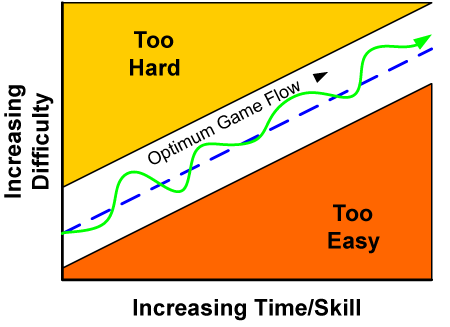 Jesper quotes Falstein's work in that difficulty progression isn't just a smooth path either, but comes in waves as the player experiences failure, then adapts and leaps back into success. Maybe little 'Aha' moments all along the journey? I'm drawn to my experience in World of Goo where each level builds on the skills of the previous level, but is not attainable by those skills alone. The problem remains interesting because there is a subtle tweak in the mechanics to allow progression. The engagement comes in finding those tweaks, experimenting with them, and building them into your repertoire for the next level.
 Could education be like that too? It smacks of self-directed learning where the student is encouraged enough to seek out answers to the problem by themselves. Maybe the last few questions in maths class should be lead-ins to the next topic? Using previously learned skills COULD get you there if you tweaked the mechanics enough. What happens to those in the class that don't get it? Doesn't seem to fit the teacher-centric model where everyone needs to be at the same level. There is always one strategy that can be used over and over; wait for the teacher to tell you the answer.
When looking at PLEs though, you have the flexibility of delivering the content to people in an individual way so that they can all keep 'in the channel'. Understanding just how much failure is required to make the material engaging would be very appropriate.
'How much failure' is probably the wrong phrase. It's not the measure of intentional failure (you don't set the curriculum to purposely make people fail), but the perceived failure that increases engagement. As long as you know you could have failed. Reminds me of an adage from Sim Golf: "A golf course should look hard, but play easy". The little sims would enjoy the sight of lots of water in front of them, but hate it if the ball went in the drink. A little water or sand placed in the hit-over zones breaks up the course into achievable chunks that made the sims feel challenged, but remain happy.
Juul's GDC talk on Beyond Balancing also indicates that the failure count can be high as long as the failure cost remains low. The failure cost, in this case, is:
Failure Cost = Failure count * Failure communication * Failure setback * Failure repititionIn a personal learning environment these would translate to:
where:
Failure count = number of fails.
Failure communication = ease of identifying why you failed.
Failure setback = how much time and energy the failure cost you.
Failure repitition = how much the task needs to exactly repeated again.
Failure count = Number of attempts to demonstrate the skill (both in a session and over multiple sessions)Failure also needs to be looked at with a positive attitude. Juul warns against learned helplessness (through attribution theory) where the attitude of the person turns pessimistic. Instead of seeing it as a challenge, they see it as a personal failing. Instead of attempting to do better next time, they give up. Instead of accepting that they may be underperforming in only one area, they see it as total failure. It looks like the psychological effects in an educational context are more grounded, so hopefully that won't be an issue to tackle just through PLEs.
Failure communication = Teacher's / curriculum's ability to highlight to the student exactly where they went wrong.
Failure setback = How much time and energy wasted on repeat attempts.
Failure repitition = Whether or not different examples can be used to demonstrate the skill.
References:
- Falstein, Noah. 2005. "Understanding Fun—The Theory of Natural Funativity". In Introduction to Game Development, ed. Steve Rabin, 71-98. Boston:Charles River Media.
- Juul, Jesper. 2009. Beyond Balancing: Using Five Elements of Failure Design to Enhance Player Experiences. GDC conference 09. http://www.jesperjuul.net/ludologist/?p=594
- Juul, Jesper. 2009. "Fear of Failing? The Many Meanings of Difficulty in Video Games" From Mark J. P. Wolf & Bernard Perron (eds.): The Video Game Theory Reader 2. New York: Routledge 2009. pp. 237-252.
Thursday, April 16, 2009
Jafari Model of PLEs
Reading through a chinese based wiki regarding Personal Learning Environments, I stumbled upon a model that utilised AIs as a core part of the PLE. Not quite the same context as my vision of learning through VR, but it's the first time I've seen a PLE and AI mix. Digging further ...
EDIT: Found the original article that outlines the key points of the new system.
EDIT: Found the original article that outlines the key points of the new system.
Follow smart people
While reviewing Web 2.0 and Your Own Learning and Development, I skimmed over a realisation I've had about using RSS as a Personal Learning Environment. I've come back to this point a couple of times in my conversations with people at school and at Uni, so I'll try to get a complete story down to reference back to...
When RSS first arrived on the scene I had looked at it and more or less rejected the technology as it required a change from all websites to expose the content in the way the reader likes. There were (and still are) a number of reasons why a websites wouldn't want to have their content taken away from their method of delivery from an advertising point of view or even just a data silo point of view. Without the majority of sites on board, RSS for the user was more potential than practical. I did dabble quite a lot with RSS though, as a back end method of integrating websites together at a corporate level.
Fast forward 5 years to the present and RSS is now more or less ubiquitous throughout the net wherever data is stored. I'd highlight Web2.0 companies as the main proponent for driving the technologgy forward as RSS enabled the mashup mentality. Maybe it was the the other way round? Maybe Web2.0 exists because of RSS? Regardless, RSS is definitely here to stay.
During the GDLT I'd been following more and more blogs to do with education, and the more I followed the more sense an RSS reader made. Combined with a need to access these from more than one computer and from more than one location (Uni, home, school), I looked into Google reader as my catchall.
It so happened that I came across a web post summarizing many thousands of votes as to what the most influential web2.0 technology was for personal learning environments. Google reader was in the top 3, along with Delicious (another web2.0 tool I'd started up with due to multiple locations). An RSS reader? What are they doing with an RSS reader as an educating tool? I could immediately see the benifits in Delicious being up so high if you had a network of friends/associates/peers to share links to. In fact I used it as the framework for a collaborative WebQuest. But RSS? Most of the uses I could think of would add to the experience, but not be at the centre of it.
After around 6 months of use, Google reader became more and more part of my daily routine. I'd also search out an RSS feed on a page rather than bookmarking it in delicious. There were so many feeds that I started to metatag, like "_critical" for blogs I really must check every time I open the reader. Google reader was also the starting point on many a journey through the web. I'd read something interesting and kick off into a new search down that rat hole, or followup with a comment, that then led to more conversations and ideas to keep track of.
Looking back one day I noticed that the change in the way I use Google Reader came from the types of people I was subscribing to. Since it stemmed from investigation through the GDLT and had a strong teaching and eLearning bent, I had continued the mentality of subscribing to people that I thought were providing insightful articles that made me think. Even in topics far removed from the GDLT, my immediate reaction to hearing a good point of view would be to dig up the RSS and subscribe. By following people that make you think, most times when I'm starting the day with Google reader I'm confronted with new ideas and challenged to dig deeper or contribute.
So to me the crux of the change can be summed up by: Follow smart people. That's how you take Google Reader and turn it into your very own PLE. Don't just follow the news and weather or your friend's Facebook feed, follow leaders in your field, follow the inspiring rebels, follow people you look up to and respect.
By the time I covered Snowdon's Web 2.0 and Your Own Learning and Development I'd seen the light. David just made it all that much brighter and with amazing clarity. PLEs aren't just a fancy word for our students, it's us too. Personal Development. Lifelong learning. Here. Now.
When RSS first arrived on the scene I had looked at it and more or less rejected the technology as it required a change from all websites to expose the content in the way the reader likes. There were (and still are) a number of reasons why a websites wouldn't want to have their content taken away from their method of delivery from an advertising point of view or even just a data silo point of view. Without the majority of sites on board, RSS for the user was more potential than practical. I did dabble quite a lot with RSS though, as a back end method of integrating websites together at a corporate level.
Fast forward 5 years to the present and RSS is now more or less ubiquitous throughout the net wherever data is stored. I'd highlight Web2.0 companies as the main proponent for driving the technologgy forward as RSS enabled the mashup mentality. Maybe it was the the other way round? Maybe Web2.0 exists because of RSS? Regardless, RSS is definitely here to stay.
During the GDLT I'd been following more and more blogs to do with education, and the more I followed the more sense an RSS reader made. Combined with a need to access these from more than one computer and from more than one location (Uni, home, school), I looked into Google reader as my catchall.
It so happened that I came across a web post summarizing many thousands of votes as to what the most influential web2.0 technology was for personal learning environments. Google reader was in the top 3, along with Delicious (another web2.0 tool I'd started up with due to multiple locations). An RSS reader? What are they doing with an RSS reader as an educating tool? I could immediately see the benifits in Delicious being up so high if you had a network of friends/associates/peers to share links to. In fact I used it as the framework for a collaborative WebQuest. But RSS? Most of the uses I could think of would add to the experience, but not be at the centre of it.
After around 6 months of use, Google reader became more and more part of my daily routine. I'd also search out an RSS feed on a page rather than bookmarking it in delicious. There were so many feeds that I started to metatag, like "_critical" for blogs I really must check every time I open the reader. Google reader was also the starting point on many a journey through the web. I'd read something interesting and kick off into a new search down that rat hole, or followup with a comment, that then led to more conversations and ideas to keep track of.
Looking back one day I noticed that the change in the way I use Google Reader came from the types of people I was subscribing to. Since it stemmed from investigation through the GDLT and had a strong teaching and eLearning bent, I had continued the mentality of subscribing to people that I thought were providing insightful articles that made me think. Even in topics far removed from the GDLT, my immediate reaction to hearing a good point of view would be to dig up the RSS and subscribe. By following people that make you think, most times when I'm starting the day with Google reader I'm confronted with new ideas and challenged to dig deeper or contribute.
So to me the crux of the change can be summed up by: Follow smart people. That's how you take Google Reader and turn it into your very own PLE. Don't just follow the news and weather or your friend's Facebook feed, follow leaders in your field, follow the inspiring rebels, follow people you look up to and respect.
By the time I covered Snowdon's Web 2.0 and Your Own Learning and Development I'd seen the light. David just made it all that much brighter and with amazing clarity. PLEs aren't just a fancy word for our students, it's us too. Personal Development. Lifelong learning. Here. Now.
Wednesday, April 15, 2009
Mahara ePortfolio
This year's GDLM 1st years are having to do a combined eLearning and Dimensions of Learning course, part of which is setting up an ePortfolio. I've offered to help tutor for the subject since I really liked the eLearning component last year and it's been pretty fun so far (albeit a bit lacking in time due to work commitments and my own assignments). I'd fiddled with a couple of the ePortfolio systems before, including the Mahara demo, and lamented about the lack of attribution that is currently on offer.
I finally bit the bullet over the weekend and set up my own ePortfolio over at Netspot (CQU shadow system). After using the system for a while it seems a little easier to get around the interface, but the integration to Moodle is the closest thing to attribution I can see. Going to have to dig into how they are doing it to see if there's any fundamental point of validation that can be translated to other web groups/organisations.
I finally bit the bullet over the weekend and set up my own ePortfolio over at Netspot (CQU shadow system). After using the system for a while it seems a little easier to get around the interface, but the integration to Moodle is the closest thing to attribution I can see. Going to have to dig into how they are doing it to see if there's any fundamental point of validation that can be translated to other web groups/organisations.
Saturday, April 04, 2009
Web 2.0 and Your Own Learning and Development
I've been circling around Stephen Downes' work over the past 2 years while digging into eLearning concepts for my GDLT course. I'm sure I've seen his name on a number of articles and comments, but never really felt the urge to chase them up. Today (gesh, yesterday now, sun's rising) I had a talk to Scot about ePortfolios which lead to my lament about their current state. During my conversation Stephen's name came up again as an example of authority via attribution. Now, during a browse of David Jones' site and following a related link to a connectivism course assignment, Stephen pops up as the course coordinator! Too many coincidences to not follow up, so I checked out his website and stumbled on the very thing I've been trying to get my head around during this past year: PLEs are not just for my future students, they are for me too...
Subscribe to:
Posts (Atom)
