I like 11 Maths B.
Today I sat in on 2 maths classes, one a grade 10 maths class and one a grade 11 Maths B class. Both classes followed a similar format of theory followed by exercizes, but the difference between the two classes were striking. Once the individual exercizes began in Grade 10, it didn't take long for the noise level to rise. Most started out on topic but eventually the conversations swung off topic as the level increased. In grade 11, the silence was deafening in contrast.
Why is that? Why would the year 11's be able to go immediately to the set task? I asked Bernie after the session and the answer seemed a combination. Firstly it usually doesn't happen like that. Absolute silence is still something to cherish. Second, Bernie moves into work faster and there is an air of expectation that everyone is keeping up. That probably only works because of the third point: they want to be there. You don't do Maths B if you're not enjoying it (or at least know you can do it).
That's the reason I want to teach senior only. The kids are there because they want to be.
Thursday, April 30, 2009

Wednesday, April 29, 2009
Steampunk glasses
It's time for a new set of glasses.
My old set have had a good run. They're light, rimless, and sit close increase visibility through the smaller than average lense size. They are also 7 years old and browning off as the transition lenses lose their transitionness. Transition lenses have been great, my 3rd set of glasses with that technology. it keeps getting better each generation, but they all seem to die the same way; they eventually end up brown. Some of the coating on the legs had peeled too, as well as a thin coating over the lense itself. The coating wasn't the transition part as they still retain the same level of brownness across the whole lense, but the ridgeline of the coating failure is starting to get into my general field of view.
K.Rudd also stepped up to the plate and offered another incentive to get new glasses. $900 would do nicely. I headed in to OPSM through the school holidays and got the checkup done. Almost the same prescription as last time. My eyes haven't changed? I'm stunned. I don't treat them very well and even the day of the eye test was off the back of an all-nighter. They must have appeared bloodshot looking into them.
Rummaging through the options for a new set, there seemed to be less options on offer than usual. I liked my old set a lot, but sadly that model had long passed its manufactured lifetime and in its place were chunkier versions. Must be a retro fad. A set of Oakleys were looking the best of the bunch, and the legs had a weird steampunk look. The brand name was 'Transistor'. Could it be that geek cred had made it into the company famous for surfing coolness?
 2 weeks later an SMS alerted me to the arrival of my new glasses. I was a little disappointed that they sit a bit further out than my other set, but a couple of adjustments and they feel Ok, albeit a little disorienting for the first couple of hours. Arriving home I showed Sandy the Coupe de grace; a cylindrical metal container with pop rivets. Steampunk it is.

My old set have had a good run. They're light, rimless, and sit close increase visibility through the smaller than average lense size. They are also 7 years old and browning off as the transition lenses lose their transitionness. Transition lenses have been great, my 3rd set of glasses with that technology. it keeps getting better each generation, but they all seem to die the same way; they eventually end up brown. Some of the coating on the legs had peeled too, as well as a thin coating over the lense itself. The coating wasn't the transition part as they still retain the same level of brownness across the whole lense, but the ridgeline of the coating failure is starting to get into my general field of view.
K.Rudd also stepped up to the plate and offered another incentive to get new glasses. $900 would do nicely. I headed in to OPSM through the school holidays and got the checkup done. Almost the same prescription as last time. My eyes haven't changed? I'm stunned. I don't treat them very well and even the day of the eye test was off the back of an all-nighter. They must have appeared bloodshot looking into them.
Rummaging through the options for a new set, there seemed to be less options on offer than usual. I liked my old set a lot, but sadly that model had long passed its manufactured lifetime and in its place were chunkier versions. Must be a retro fad. A set of Oakleys were looking the best of the bunch, and the legs had a weird steampunk look. The brand name was 'Transistor'. Could it be that geek cred had made it into the company famous for surfing coolness?
 2 weeks later an SMS alerted me to the arrival of my new glasses. I was a little disappointed that they sit a bit further out than my other set, but a couple of adjustments and they feel Ok, albeit a little disorienting for the first couple of hours. Arriving home I showed Sandy the Coupe de grace; a cylindrical metal container with pop rivets. Steampunk it is.
Tuesday, April 28, 2009
A model of Play
Raph Koster drew attention to an interesting model of play where it is always assumed that play is an interaction between participants (either people, virtual characters, or mindsets). The complete model is a little overwhelming, but the buildup of the model is well worth a read.
The cycles have me a little confused though. The cycle of play has only action / observe / assess / plan / action between the entities. From the model proposed this would therefore be actions in the absence of the conversation, engagement and ultimately fun. Can play exist without those? It would seem that the buildup of the model of play was to advocate fun through engagement, so without these elements the cycle of play doesn't make sense.
On the other hand, the cycle of fun seems to run through action / conversation / shared world / engagement / fun, but doesn't include observing and reacting to other actions. Can you have a conversation or a shared world without the actions and reactions of both parties?
The cycle of learning is interesting in its elimination of fun and in turn preferring to end the engagement to reflect and absorb the activity into experience. With a lot of emphasis placed on engagement as a highly desired attribute for the classroom, it seems odd that the engagement would need to end for the learning to begin. I can see that they are trying to describe the reflective process of learning, but is that all there is out of a play environment?
The cycle of repeated play seems sad. Without fun, experience or goals, repeated play is like being stuck in a rut. I hope I never get to experience that.
I'd really like to see some examples of what Dubberly Design had in mind for each of the cycles. What they are and what they are not. It seems to be an interesting model for looking into how to make games (and classes!) more engaging, or to diagnose what caused a lack of fun.
I just finished my first prac with the grade 10's on games programming and I'd hurredly copied down this model before rushing to class. I didn't get to it (took too long talking about good games vs bad games and distilling attributes), but I'll keep it in mind for a pep talk 1/2 way through the term.
The cycles have me a little confused though. The cycle of play has only action / observe / assess / plan / action between the entities. From the model proposed this would therefore be actions in the absence of the conversation, engagement and ultimately fun. Can play exist without those? It would seem that the buildup of the model of play was to advocate fun through engagement, so without these elements the cycle of play doesn't make sense.
On the other hand, the cycle of fun seems to run through action / conversation / shared world / engagement / fun, but doesn't include observing and reacting to other actions. Can you have a conversation or a shared world without the actions and reactions of both parties?
The cycle of learning is interesting in its elimination of fun and in turn preferring to end the engagement to reflect and absorb the activity into experience. With a lot of emphasis placed on engagement as a highly desired attribute for the classroom, it seems odd that the engagement would need to end for the learning to begin. I can see that they are trying to describe the reflective process of learning, but is that all there is out of a play environment?
The cycle of repeated play seems sad. Without fun, experience or goals, repeated play is like being stuck in a rut. I hope I never get to experience that.
I'd really like to see some examples of what Dubberly Design had in mind for each of the cycles. What they are and what they are not. It seems to be an interesting model for looking into how to make games (and classes!) more engaging, or to diagnose what caused a lack of fun.
I just finished my first prac with the grade 10's on games programming and I'd hurredly copied down this model before rushing to class. I didn't get to it (took too long talking about good games vs bad games and distilling attributes), but I'll keep it in mind for a pep talk 1/2 way through the term.
Wednesday, April 22, 2009
Tuesday, April 21, 2009
Where to host moodle?
CQU is going through a little debate on the merits of hosting a new LMS either inside the campus, or externally with another organization. This has led to Mahara ePortfolios along with the current moodle implementation being hosted off-site.
I've also been going through this quandry as Personal Learning becomes more and more clear to me. I've been rebuilding a moodle site here at St.Luke's for use next term while I'm teaching, but should it be here? Should I be encouraging the kids to set out their own personal environment that they can keep forever?
OLDaily pointed to Terry Anderson's article regarding My place or yours? A look into the same problem.
I'm leaning toward the front yard approach. I believe it's the institution's responsibility to provide an environment for learning, and the investment in retaining past students within the same system (but accessing different resources) for lifelong learning provides an enduring advertisement for that institution. As more and more educational bodies move toward an open virtual environment devoid of buildings to mark their presence, the affiliation toward an institution through the daily support of resources and links back to previous material is essential.
I've also been going through this quandry as Personal Learning becomes more and more clear to me. I've been rebuilding a moodle site here at St.Luke's for use next term while I'm teaching, but should it be here? Should I be encouraging the kids to set out their own personal environment that they can keep forever?
OLDaily pointed to Terry Anderson's article regarding My place or yours? A look into the same problem.
I'm leaning toward the front yard approach. I believe it's the institution's responsibility to provide an environment for learning, and the investment in retaining past students within the same system (but accessing different resources) for lifelong learning provides an enduring advertisement for that institution. As more and more educational bodies move toward an open virtual environment devoid of buildings to mark their presence, the affiliation toward an institution through the daily support of resources and links back to previous material is essential.
Monday, April 20, 2009
From the troughs to the mountains
Over the weekend I reviewed my VR learning environment with Mum, Dad & Sandy as to how it would cope as a solution to gifted and talented students (assignment topic for Supportive Learning Environments in the GDLT). I wasn't expecting to go there, really I wasn't, but reading through the textbook on the topic made me realize something about the model:
Scaffold the day from weaker skills to excelling skills.
The positives in doing this would be:
- Retaining some level of same-age courses: Since the students at the start of the day are all taking their relatively weaker skills, they would all more likely end up in a classroom with age-alike students rather than a hodge-podge of student ages. I'm still digging to see whether there are any real ramifications to having only merit based entry into sessions with no age based grouping at all. It would seem that schools are flipping between streaming and integration with no real winner so far, and since that PLEs through VR would be an aggressive streaming process I'll need to dig into all the different reasons why age based integration is still advocated. Hopefully it's more about the diversity aspect (that PLEs through VR will have in spades) and not the same-age traits. If there are any same-age issues then hopefully structuring the day in this manner will limit their impact.
- emphasized goal setting: The skill trained in the last session would be a peak skill, one that the student is excelling in. Those peak skills are more likely to have entry requirements further down the skill tree that the student has not yet attained, the 'ridge skills' of the mountain. These ridge skills would also have requirements of other skills further down the ridge until you finally reach a valley of skills not yet know, but required to advance the peak further. Ideally the valley skills attained in the morning enable ridge skills for the middle session, then enable a new peak skill. This would build a direct causal relationship between studying the skills that they may not like by giving them direction as to how those skills build into something they do like.
Scaffold the day from weaker skills to excelling skills.
The positives in doing this would be:
- Retaining some level of same-age courses: Since the students at the start of the day are all taking their relatively weaker skills, they would all more likely end up in a classroom with age-alike students rather than a hodge-podge of student ages. I'm still digging to see whether there are any real ramifications to having only merit based entry into sessions with no age based grouping at all. It would seem that schools are flipping between streaming and integration with no real winner so far, and since that PLEs through VR would be an aggressive streaming process I'll need to dig into all the different reasons why age based integration is still advocated. Hopefully it's more about the diversity aspect (that PLEs through VR will have in spades) and not the same-age traits. If there are any same-age issues then hopefully structuring the day in this manner will limit their impact.
- emphasized goal setting: The skill trained in the last session would be a peak skill, one that the student is excelling in. Those peak skills are more likely to have entry requirements further down the skill tree that the student has not yet attained, the 'ridge skills' of the mountain. These ridge skills would also have requirements of other skills further down the ridge until you finally reach a valley of skills not yet know, but required to advance the peak further. Ideally the valley skills attained in the morning enable ridge skills for the middle session, then enable a new peak skill. This would build a direct causal relationship between studying the skills that they may not like by giving them direction as to how those skills build into something they do like.
Not to easy, not too tough: A difficulty level for Education?
After listening to the latest Brainy Gamer podcast, the topic of setting difficulty level came up as a balancing act for engagement. Too hard and the player gives up in disgust and doesn't enjoy it, too easy and the game is boring with no real rewards. Michael brought in Jesper Juul's Fear of Failing article as a baseline for difficulty setting in modern computer games. It struck me, though, that this kind of engagement through difficulty settings could also help in the broader educational environment, and would be greater achieved through personal learning environments.
 Jesper quotes Falstein's work in that difficulty progression isn't just a smooth path either, but comes in waves as the player experiences failure, then adapts and leaps back into success. Maybe little 'Aha' moments all along the journey? I'm drawn to my experience in World of Goo where each level builds on the skills of the previous level, but is not attainable by those skills alone. The problem remains interesting because there is a subtle tweak in the mechanics to allow progression. The engagement comes in finding those tweaks, experimenting with them, and building them into your repertoire for the next level.
Could education be like that too? It smacks of self-directed learning where the student is encouraged enough to seek out answers to the problem by themselves. Maybe the last few questions in maths class should be lead-ins to the next topic? Using previously learned skills COULD get you there if you tweaked the mechanics enough. What happens to those in the class that don't get it? Doesn't seem to fit the teacher-centric model where everyone needs to be at the same level. There is always one strategy that can be used over and over; wait for the teacher to tell you the answer.
When looking at PLEs though, you have the flexibility of delivering the content to people in an individual way so that they can all keep 'in the channel'. Understanding just how much failure is required to make the material engaging would be very appropriate.
'How much failure' is probably the wrong phrase. It's not the measure of intentional failure (you don't set the curriculum to purposely make people fail), but the perceived failure that increases engagement. As long as you know you could have failed. Reminds me of an adage from Sim Golf: "A golf course should look hard, but play easy". The little sims would enjoy the sight of lots of water in front of them, but hate it if the ball went in the drink. A little water or sand placed in the hit-over zones breaks up the course into achievable chunks that made the sims feel challenged, but remain happy.
Juul's GDC talk on Beyond Balancing also indicates that the failure count can be high as long as the failure cost remains low. The failure cost, in this case, is:
References:
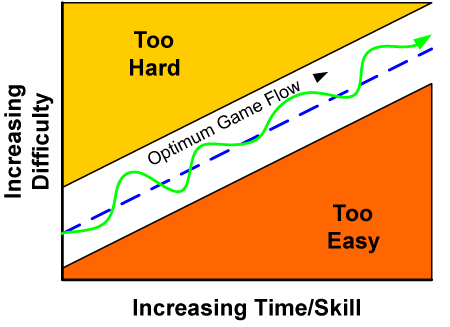 Jesper quotes Falstein's work in that difficulty progression isn't just a smooth path either, but comes in waves as the player experiences failure, then adapts and leaps back into success. Maybe little 'Aha' moments all along the journey? I'm drawn to my experience in World of Goo where each level builds on the skills of the previous level, but is not attainable by those skills alone. The problem remains interesting because there is a subtle tweak in the mechanics to allow progression. The engagement comes in finding those tweaks, experimenting with them, and building them into your repertoire for the next level.
 Could education be like that too? It smacks of self-directed learning where the student is encouraged enough to seek out answers to the problem by themselves. Maybe the last few questions in maths class should be lead-ins to the next topic? Using previously learned skills COULD get you there if you tweaked the mechanics enough. What happens to those in the class that don't get it? Doesn't seem to fit the teacher-centric model where everyone needs to be at the same level. There is always one strategy that can be used over and over; wait for the teacher to tell you the answer.
When looking at PLEs though, you have the flexibility of delivering the content to people in an individual way so that they can all keep 'in the channel'. Understanding just how much failure is required to make the material engaging would be very appropriate.
'How much failure' is probably the wrong phrase. It's not the measure of intentional failure (you don't set the curriculum to purposely make people fail), but the perceived failure that increases engagement. As long as you know you could have failed. Reminds me of an adage from Sim Golf: "A golf course should look hard, but play easy". The little sims would enjoy the sight of lots of water in front of them, but hate it if the ball went in the drink. A little water or sand placed in the hit-over zones breaks up the course into achievable chunks that made the sims feel challenged, but remain happy.
Juul's GDC talk on Beyond Balancing also indicates that the failure count can be high as long as the failure cost remains low. The failure cost, in this case, is:
Failure Cost = Failure count * Failure communication * Failure setback * Failure repititionIn a personal learning environment these would translate to:
where:
Failure count = number of fails.
Failure communication = ease of identifying why you failed.
Failure setback = how much time and energy the failure cost you.
Failure repitition = how much the task needs to exactly repeated again.
Failure count = Number of attempts to demonstrate the skill (both in a session and over multiple sessions)Failure also needs to be looked at with a positive attitude. Juul warns against learned helplessness (through attribution theory) where the attitude of the person turns pessimistic. Instead of seeing it as a challenge, they see it as a personal failing. Instead of attempting to do better next time, they give up. Instead of accepting that they may be underperforming in only one area, they see it as total failure. It looks like the psychological effects in an educational context are more grounded, so hopefully that won't be an issue to tackle just through PLEs.
Failure communication = Teacher's / curriculum's ability to highlight to the student exactly where they went wrong.
Failure setback = How much time and energy wasted on repeat attempts.
Failure repitition = Whether or not different examples can be used to demonstrate the skill.
References:
- Falstein, Noah. 2005. "Understanding Fun—The Theory of Natural Funativity". In Introduction to Game Development, ed. Steve Rabin, 71-98. Boston:Charles River Media.
- Juul, Jesper. 2009. Beyond Balancing: Using Five Elements of Failure Design to Enhance Player Experiences. GDC conference 09. http://www.jesperjuul.net/ludologist/?p=594
- Juul, Jesper. 2009. "Fear of Failing? The Many Meanings of Difficulty in Video Games" From Mark J. P. Wolf & Bernard Perron (eds.): The Video Game Theory Reader 2. New York: Routledge 2009. pp. 237-252.
Thursday, April 16, 2009
Jafari Model of PLEs
Reading through a chinese based wiki regarding Personal Learning Environments, I stumbled upon a model that utilised AIs as a core part of the PLE. Not quite the same context as my vision of learning through VR, but it's the first time I've seen a PLE and AI mix. Digging further ...
EDIT: Found the original article that outlines the key points of the new system.
EDIT: Found the original article that outlines the key points of the new system.
Follow smart people
While reviewing Web 2.0 and Your Own Learning and Development, I skimmed over a realisation I've had about using RSS as a Personal Learning Environment. I've come back to this point a couple of times in my conversations with people at school and at Uni, so I'll try to get a complete story down to reference back to...
When RSS first arrived on the scene I had looked at it and more or less rejected the technology as it required a change from all websites to expose the content in the way the reader likes. There were (and still are) a number of reasons why a websites wouldn't want to have their content taken away from their method of delivery from an advertising point of view or even just a data silo point of view. Without the majority of sites on board, RSS for the user was more potential than practical. I did dabble quite a lot with RSS though, as a back end method of integrating websites together at a corporate level.
Fast forward 5 years to the present and RSS is now more or less ubiquitous throughout the net wherever data is stored. I'd highlight Web2.0 companies as the main proponent for driving the technologgy forward as RSS enabled the mashup mentality. Maybe it was the the other way round? Maybe Web2.0 exists because of RSS? Regardless, RSS is definitely here to stay.
During the GDLT I'd been following more and more blogs to do with education, and the more I followed the more sense an RSS reader made. Combined with a need to access these from more than one computer and from more than one location (Uni, home, school), I looked into Google reader as my catchall.
It so happened that I came across a web post summarizing many thousands of votes as to what the most influential web2.0 technology was for personal learning environments. Google reader was in the top 3, along with Delicious (another web2.0 tool I'd started up with due to multiple locations). An RSS reader? What are they doing with an RSS reader as an educating tool? I could immediately see the benifits in Delicious being up so high if you had a network of friends/associates/peers to share links to. In fact I used it as the framework for a collaborative WebQuest. But RSS? Most of the uses I could think of would add to the experience, but not be at the centre of it.
After around 6 months of use, Google reader became more and more part of my daily routine. I'd also search out an RSS feed on a page rather than bookmarking it in delicious. There were so many feeds that I started to metatag, like "_critical" for blogs I really must check every time I open the reader. Google reader was also the starting point on many a journey through the web. I'd read something interesting and kick off into a new search down that rat hole, or followup with a comment, that then led to more conversations and ideas to keep track of.
Looking back one day I noticed that the change in the way I use Google Reader came from the types of people I was subscribing to. Since it stemmed from investigation through the GDLT and had a strong teaching and eLearning bent, I had continued the mentality of subscribing to people that I thought were providing insightful articles that made me think. Even in topics far removed from the GDLT, my immediate reaction to hearing a good point of view would be to dig up the RSS and subscribe. By following people that make you think, most times when I'm starting the day with Google reader I'm confronted with new ideas and challenged to dig deeper or contribute.
So to me the crux of the change can be summed up by: Follow smart people. That's how you take Google Reader and turn it into your very own PLE. Don't just follow the news and weather or your friend's Facebook feed, follow leaders in your field, follow the inspiring rebels, follow people you look up to and respect.
By the time I covered Snowdon's Web 2.0 and Your Own Learning and Development I'd seen the light. David just made it all that much brighter and with amazing clarity. PLEs aren't just a fancy word for our students, it's us too. Personal Development. Lifelong learning. Here. Now.
When RSS first arrived on the scene I had looked at it and more or less rejected the technology as it required a change from all websites to expose the content in the way the reader likes. There were (and still are) a number of reasons why a websites wouldn't want to have their content taken away from their method of delivery from an advertising point of view or even just a data silo point of view. Without the majority of sites on board, RSS for the user was more potential than practical. I did dabble quite a lot with RSS though, as a back end method of integrating websites together at a corporate level.
Fast forward 5 years to the present and RSS is now more or less ubiquitous throughout the net wherever data is stored. I'd highlight Web2.0 companies as the main proponent for driving the technologgy forward as RSS enabled the mashup mentality. Maybe it was the the other way round? Maybe Web2.0 exists because of RSS? Regardless, RSS is definitely here to stay.
During the GDLT I'd been following more and more blogs to do with education, and the more I followed the more sense an RSS reader made. Combined with a need to access these from more than one computer and from more than one location (Uni, home, school), I looked into Google reader as my catchall.
It so happened that I came across a web post summarizing many thousands of votes as to what the most influential web2.0 technology was for personal learning environments. Google reader was in the top 3, along with Delicious (another web2.0 tool I'd started up with due to multiple locations). An RSS reader? What are they doing with an RSS reader as an educating tool? I could immediately see the benifits in Delicious being up so high if you had a network of friends/associates/peers to share links to. In fact I used it as the framework for a collaborative WebQuest. But RSS? Most of the uses I could think of would add to the experience, but not be at the centre of it.
After around 6 months of use, Google reader became more and more part of my daily routine. I'd also search out an RSS feed on a page rather than bookmarking it in delicious. There were so many feeds that I started to metatag, like "_critical" for blogs I really must check every time I open the reader. Google reader was also the starting point on many a journey through the web. I'd read something interesting and kick off into a new search down that rat hole, or followup with a comment, that then led to more conversations and ideas to keep track of.
Looking back one day I noticed that the change in the way I use Google Reader came from the types of people I was subscribing to. Since it stemmed from investigation through the GDLT and had a strong teaching and eLearning bent, I had continued the mentality of subscribing to people that I thought were providing insightful articles that made me think. Even in topics far removed from the GDLT, my immediate reaction to hearing a good point of view would be to dig up the RSS and subscribe. By following people that make you think, most times when I'm starting the day with Google reader I'm confronted with new ideas and challenged to dig deeper or contribute.
So to me the crux of the change can be summed up by: Follow smart people. That's how you take Google Reader and turn it into your very own PLE. Don't just follow the news and weather or your friend's Facebook feed, follow leaders in your field, follow the inspiring rebels, follow people you look up to and respect.
By the time I covered Snowdon's Web 2.0 and Your Own Learning and Development I'd seen the light. David just made it all that much brighter and with amazing clarity. PLEs aren't just a fancy word for our students, it's us too. Personal Development. Lifelong learning. Here. Now.
Wednesday, April 15, 2009
Mahara ePortfolio
This year's GDLM 1st years are having to do a combined eLearning and Dimensions of Learning course, part of which is setting up an ePortfolio. I've offered to help tutor for the subject since I really liked the eLearning component last year and it's been pretty fun so far (albeit a bit lacking in time due to work commitments and my own assignments). I'd fiddled with a couple of the ePortfolio systems before, including the Mahara demo, and lamented about the lack of attribution that is currently on offer.
I finally bit the bullet over the weekend and set up my own ePortfolio over at Netspot (CQU shadow system). After using the system for a while it seems a little easier to get around the interface, but the integration to Moodle is the closest thing to attribution I can see. Going to have to dig into how they are doing it to see if there's any fundamental point of validation that can be translated to other web groups/organisations.
I finally bit the bullet over the weekend and set up my own ePortfolio over at Netspot (CQU shadow system). After using the system for a while it seems a little easier to get around the interface, but the integration to Moodle is the closest thing to attribution I can see. Going to have to dig into how they are doing it to see if there's any fundamental point of validation that can be translated to other web groups/organisations.
Subscribe to:
Posts (Atom)
